

How to judge placement quality
Confused by “100% placement” claims? A simple, honest guide for Tamil Nadu Class 11–12 students to judge real engineering placement quality and choose better colleges.
These days, every college you see is loudly claiming “100% placement” or showing off some huge salary package. And if you’re in Class 11 or 12 in Tamil Nadu, it’s honestly very normal to feel confused by all of this. Anyone in your place would wonder what’s true, what’s just clever advertising, and whether engineering will actually give you a steady, decent first job after four years.
This guide is meant to talk to you the way a real mentor would — the kind who sits with you, listens, and explains things without trying to sell you a dream. By the time you finish reading, the hope is that you’ll know which details actually matter, which ones you don’t need to stress about, and how to make a calm, sensible decision with your parents.
Why placements matter, but are not everything
For Tamil Nadu families, engineering represents stability and upward growth. Parents invest in fees because they see it as leading to a secure job. But placements are not the only factor influencing your future. Your branch, projects, skills, communication, confidence, and teaching quality shape your long-term path. A college with honest outcomes and steady training is far safer than one highlighting extreme packages
The real situation in India and Tamil Nadu
Tamil Nadu has many engineering colleges with widely varying quality. A few maintain strong placement records and industry partnerships; many manage only partial placements or low-paying roles. This doesn't mean engineering is bad—it means you cannot choose by marketing slogans. Understand genuine numbers: how many students were actually placed, which companies visited, what roles they offered, and typical salary. Complete Guide to Engineering Entrance Exams for Tamil Nadu Students
The key placement numbers you must understand
On brochures and websites, you will usually see these words: placement percentage, highest package, average salary, median salary, and number of companies. Placement percentage tells you what share of eligible students actually got at least one offer; strong colleges often show high percentages for popular branches.
Median salary is one of the most honest numbers. When you arrange all salary offers from lowest to highest, the middle value is the median. It shows what a “typical” student gets, and NIRF uses median salary as a key parameter for ranking colleges on graduation outcomes. Average salary can be affected by a few very high or very low packages. Highest salary is usually for one or two students and should never be the main deciding factor for you.
Seeing through “100% placement” claims
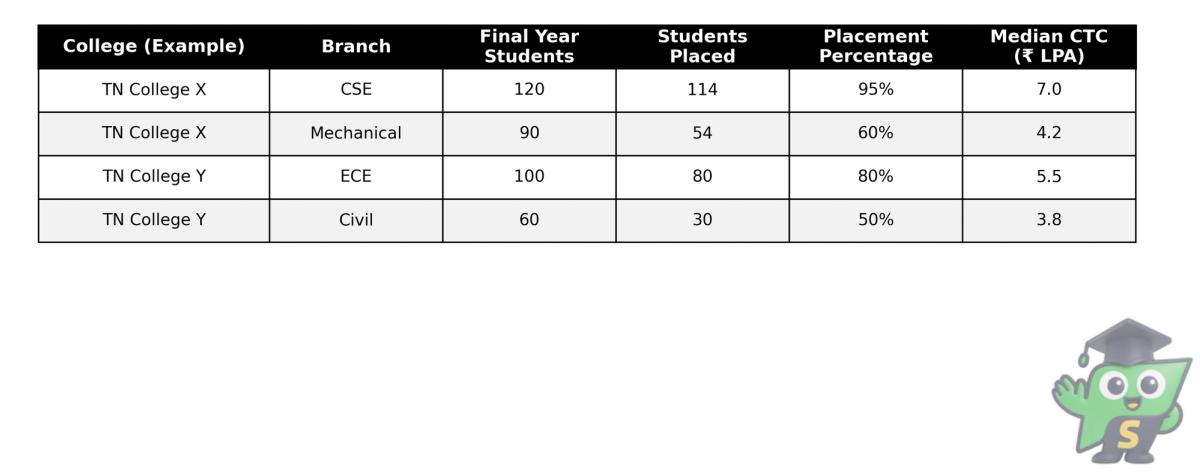
"100% placement" is common but often misleading. Colleges may discourage weaker students from placement drives, count low-paying internships as placements, or show one student's multiple offers as many placements. Ask: How many final-year students are there? How many registered for placements? How many got job offers? What is branch-wise median CTC? If a college refuses these numbers, something is usually wrong.
How NIRF helps you judge placements
NIRF provides reliable, government-audited data: number of graduates, placements, higher studies, and median salary. This helps you compare fairly. But NIRF includes teaching quality, research, and reputation, so a college might rank well overall even if one branch's placements are average. Always combine NIRF data with branch-wise placement info and alumni feedback. What rank is needed for NIT Trichy
Branch-wise placement reality
CSE, IT, ECE, AI & ML, and Data Science attract more recruiters and better packages due to software industry demand. Core branches like Mechanical, Civil, Electrical, and Chemical have fewer on-campus roles and may rely on off-campus jobs, government exams, or higher studies. This doesn't mean avoid core branches if you enjoy them—just be realistic. A college's 90% placement claim may hide that only certain branches are strong. Always look for branch-wise data and talk to seniors from your branch. TNEA vs COMEDK
Salary numbers and ROI for your family
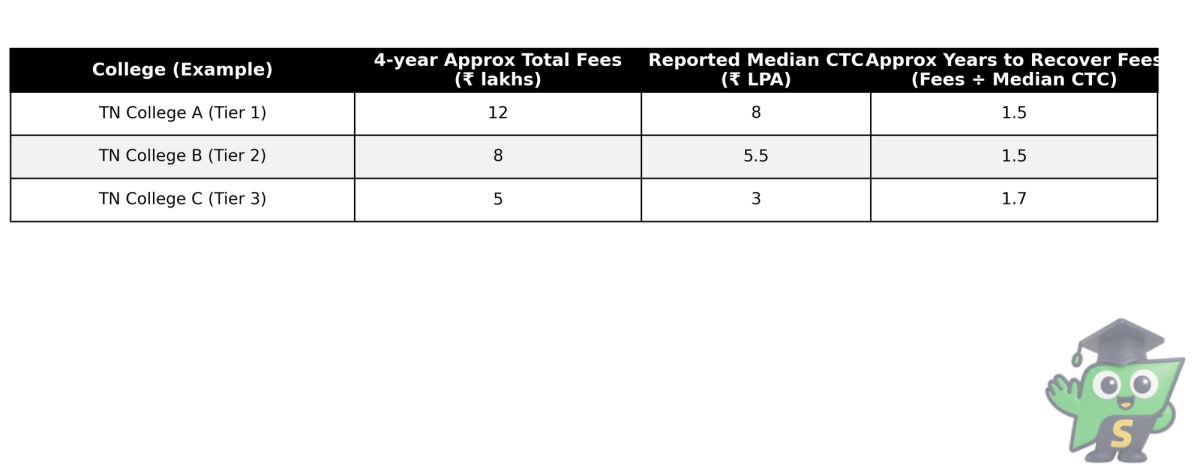
For many Tamil Nadu families, the silent question is: “If we spend so many lakhs in four years, what will be the starting salary?” This is basically return on investment, or ROI. A college with moderate fees and solid median salaries can give you a better ROI than a very expensive college with only slightly higher placements.
When you look at salary data, do not get hypnotised by the biggest package. Look at median salary, and also at the range most students fall into. Remember to count hostel, mess, travel, and other costs when you estimate total spending. Then think: at this median salary, roughly how many years will it take to recover the fees?
College Fees vs Typical Placement Salary
Companies, roles, and long-term growth
Good placement quality depends on the kind of companies and roles you get. Product-based tech companies and core engineering firms often offer stronger learning and faster growth, even if starting salaries are slightly higher. Mass IT service roles can be a decent first step when the alternative is no job. Look at the spread of sectors visiting campus: software, electronics, manufacturing, analytics, consulting. Check if core branches get core profiles or if everyone is pushed into generic roles. Talk to alumni on LinkedIn or through seniors to see what the job actually looks like after placement.
How training and campus culture influence placements
Placements start from first year, not the final semester. Colleges running continuous aptitude, coding, communication, and interview training tend to have better outcomes. Campus culture matters as much as formal training. If students participate in coding contests, hackathons, competitions, and clubs, they build better resumes and confidence. Ask students: from which semester did training start, how regular is it, and how useful? Their answers reveal more than brochures.
Common mistakes students make
Do not trust random "Top 20 colleges with 100% placement" lists on social media without checking year, source, or bias. Another mistake is looking only at superstar offers and assuming everyone gets similar. Instead ask: "For an average student in my branch, what is a likely outcome?" Look at three-year placement trends and median salary where possible—NIRF and many institutes publish multi-batch averages. This gives a more stable picture than one lucky year.
How parents can support without adding pressure
Parents can support better by sitting down with their child, calmly going through realistic options: NITs and IIITs through JEE Main and JoSAA, good private institutes, and strong state colleges through TNEA. Should Tamil Nadu Students Write JEE? Ask what kind of work the child can imagine doing, and then look at branches and placement data that match that path. Keep reminding them that marks and ranks are important, but their worth as a person is far bigger than any package.
Using simple tables at home
When results are out and counseling starts, the number of options can explode. To avoid panic, put information on paper. For your top three to five realistic colleges, write down branch-wise placement percentage, median CTC, total four-year fees, and distance from home. How to prepare for TNEA cut off based admissions
Branch-wise Placement Analysis
Entrance exams, ranks, and placement ecosystems
Your JEE Main score, TNEA rank, and performance in exams like COMEDK decide which placement ecosystem you enter, because they control which colleges and branches you can access. Good ranks can open doors to NIT Trichy, IIITs, and strong private colleges that show consistently high placement percentages and median salaries. Complete Guide to Engineering Entrance Exams for Tamil Nadu Students
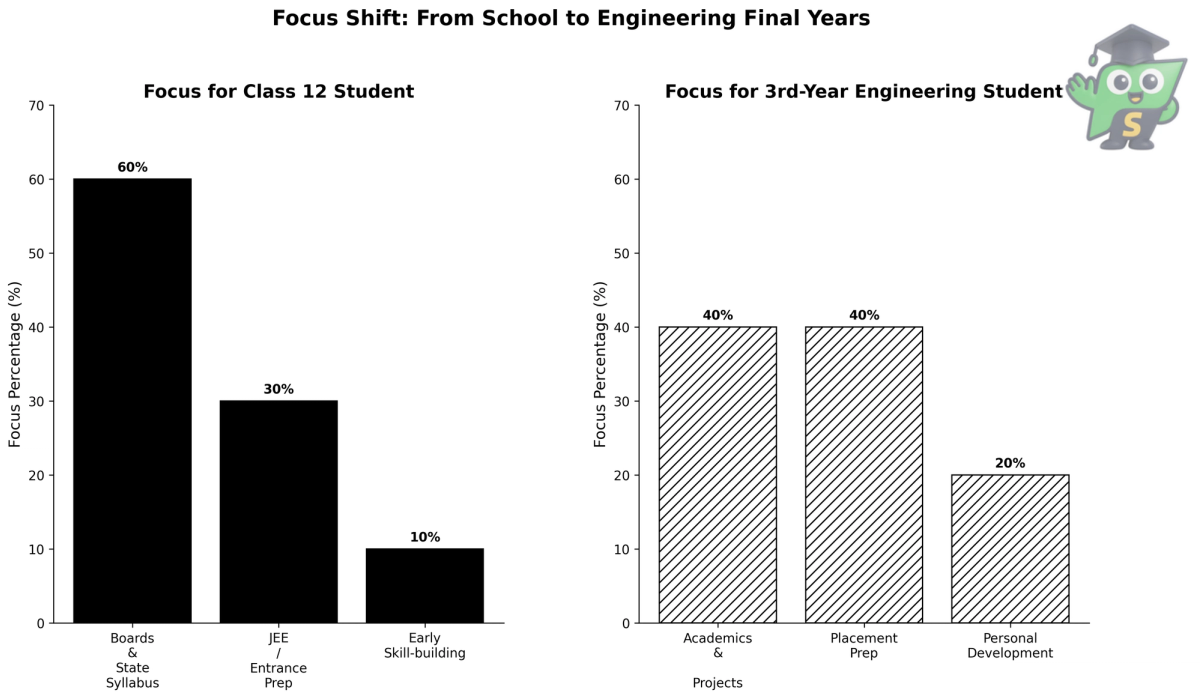
If your rank is not what you hoped, it does not end your story. It simply means you may need to be more proactive in college: focus on projects, coding, internships, and off-campus drives. Plan your study time so that you balance board exams, entrance preparation, and early skill-building. How to Manage Both Board Exams and JEE
When to think about a drop year
Sometimes, after seeing actual options, you may feel that all available colleges and branches have weak placements and you start thinking about a drop year. A drop year can be meaningful if you have a clear, realistic target (for example, moving from a low-tier college to NIT Trichy or a top private institute), a structured plan, and strong emotional and financial support. How to decide if a student must attempt a drop year
How Prof Sam can stand beside you
All these layers—placement percentages, NIRF data, fees, ranks, branches, drop-year confusion—can feel heavy when you are already stressed about exams. Prof Sam’s counselling is designed exactly for this situation. Through one-to-one, Tamil Nadu–focused guidance, you and your parents can build a realistic college and branch list, compare placement quality, and plan a strategy for JEE Main, TNEA, COMEDK, NITs, IIITs, and strong private colleges. Should Tamil Nadu Students Write JEE? TNEA vs COMEDK
Other Helpful Guides for Your Journey
Here are internal links you may want to explore next:
📌 How to judge placement quality
📌 How to compare fees and ROI
📌 What to ask during college campus visits
📌 Should students prefer tier two colleges with good placements
📌 How to compare private colleges
📌 NRI quota college selection
📌 How students can avoid marketing traps by colleges
📌 How to compare first year experience across colleges
📌 What makes a good engineering culture
You are more than a placement number
With so much talk about marks, ranks, salaries, and percentiles, it is easy to forget that you are a human being first. Your value does not depend on a CTC or a NIRF rank. Placements are important milestones, but they are not the final measure of your worth.
If things do not go exactly as planned—if you do not get your dream college, or your first job is modest—breathe. Your journey is still very much alive. With honest information, steady effort, and the right support, you can build a meaningful career from many different starting points. And whenever the noise of “100% placement” and “highest package” becomes too much, remember this: it is okay to pause, ask questions, and ask for help.
Need Personalized Guidance?
Book a consultation with Prof Sam and get expert advice tailored to your child's unique needs.
Book Your Consultation