

What makes a good engineering culture
Understand what makes a good engineering culture and how Tamil Nadu students can choose the right college, branch, and exam path with confidence.
When you think about engineering, you probably think of marks, ranks, cutoffs, college names, and "placement record". But what will shape your real life for four long years is something deeper: the engineering culture of the college and department you join. A strong culture can transform your confidence, skills, and mindset, while a poor one can make even a bright student feel stuck and disappointed.
If you are in Class 11 or 12 in Tamil Nadu, this idea can feel very distant. Relatives keep saying "Just get any CSE seat, that is enough" or "Only big city colleges matter". At the same time, you keep hearing that engineering seats are vacant and not every graduate gets a good job. It is natural to wonder: "How do I know if a college is good beyond the name and building?"
What "engineering culture" actually means
Engineering culture is what you feel every day on campus: the way classes run, how teachers interact with students, what seniors talk about, and what the department really values. It is the entire atmosphere that pushes you either towards growth or towards "just pass somehow".
In a good engineering culture, asking doubts is welcomed, not punished. Teachers become mentors you can approach when confused about subjects or projects. Students talk about what they are building, what competitions they are attending, and what internships they are trying for. Slowly, this environment makes it normal to aim higher and think like an engineer, not just a marks-chaser.
Why this matters in Tamil Nadu
Tamil Nadu has a huge number of engineering colleges—both excellent institutes with strong placements and colleges where faculty shortages, weak labs, and purely exam-oriented teaching make it hard for students to grow. On paper, both may look similar: AICTE approved, similar fees, similar branches. But the internal culture is very different.
Because of this uneven quality, many graduates from weaker colleges struggle to get core or good IT jobs. Companies prefer campuses where students have strong fundamentals and project exposure. So when your family talks about "best engineering colleges India", "CSE placements India", or "private engineering colleges ROI", what they are actually searching for is a place with a strong engineering culture.
How healthy engineering culture looks
Imagine joining a college where the department has stable, experienced faculty who stay for years. They keep updating themselves, attend workshops, and bring real-world examples into classrooms. Lab sessions are for trying things, experimenting, and learning—not just writing records. Students are encouraged to participate in tech festivals, hackathons, and coding contests.
Seniors guide you on which electives to choose, how to prepare for internships, and how to build a project portfolio. There are active clubs for coding, robotics, electronics, and AI. You may see teams preparing for national competitions or working with industry. After four years, your resume shows real skills, projects, internships, and confidence—not just a degree.
How weak culture traps students
Now imagine the opposite. The building looks polished, but inside, many classes are handled by very junior staff. Teaching is rushed, focused mainly on exam questions. Labs use old experiments, and students copy outputs from seniors' records. If you ask a question outside printed notes, some teachers feel irritated. Slowly, students learn that silence is safer than curiosity.
In hostels, you hear more talk of "how to manage attendance" and "which guide will leak questions" than about projects and internships. Technical clubs are inactive or just on paper. Placement training might start only in final year, and many companies offer low-pay roles. Even if you were once excited about engineering, your energy can go down year after year.
Academics, projects, and industry connect
A good engineering culture balances three things: solid academics, meaningful projects, and real industry connection. Academics mean you actually understand core subjects. Projects mean you apply those concepts to build something—like a basic app, simple circuit, or mini-design. Industry connect means guest lectures, internships, and curriculum reflecting current technologies.
In branches like CSE, IT, AI & DS, and ECE, this industry link is especially important because technologies change fast. Colleges that encourage updated labs, coding contests, and internships produce students ready for software and analytics roles. That is where the best "CSE placements India" come from—not just the famous name, but years of culture-driven practice. When you think about "private engineering colleges ROI", include all these cultural elements, not only the highest package number.
Culture vs Outcomes
How to judge culture before joining
During campus visits or counseling, focus less on buildings and more on conversations. Talk to existing students and ask what projects they did, how helpful teachers are, and how active clubs really are. Ask about internships, coding contests, and how they prepare for jobs.
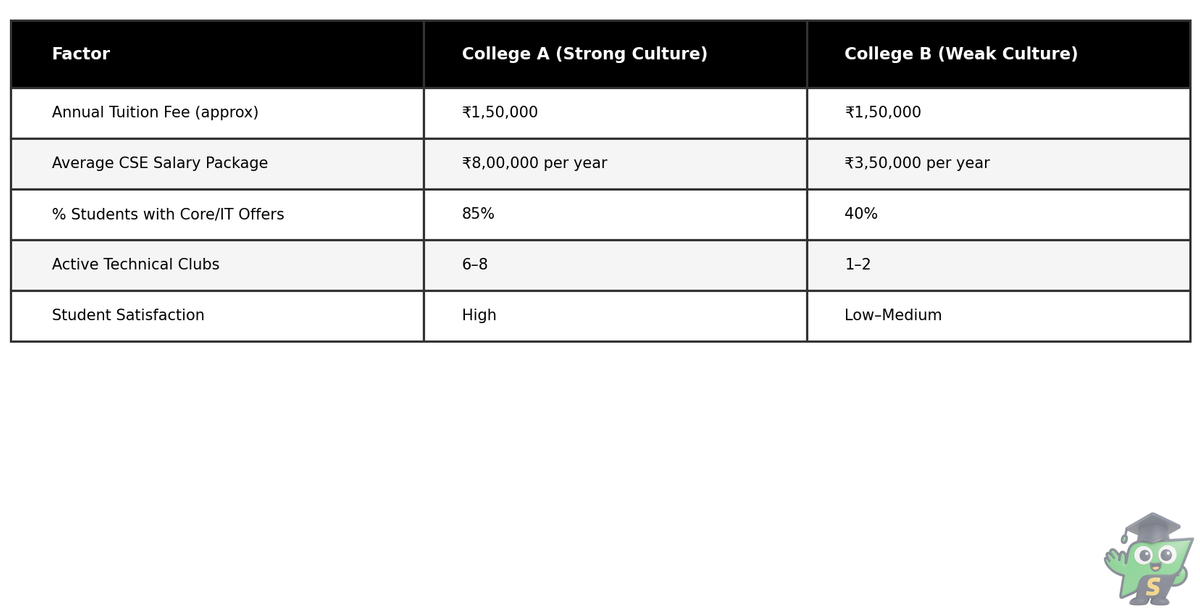
Look closely at placements. Do not look only at highest package. See what percentage of students get placed in core or good IT jobs, and what average packages look like. Think of this as return on your four-year investment, especially for NRI quota colleges or higher-fee private colleges. Culture shows up in consistent outcomes, not just flashy headlines.
Common mistakes students make
One common mistake is thinking "If I just get any CSE seat, life is set." The same degree from two colleges can mean very different skills and placements. Another mistake is believing marketing brochures. Without asking deeper questions, students only learn the truth after joining.
A second mistake is ignoring fit. Some students choose branches purely based on trend, not interest. Even in a good culture, if your branch does not match your interest, you may feel stuck. Correcting these mistakes means slowing down, reflecting on what you enjoy, and talking with mentors rather than rushing with fear.
How parents can support
Look beyond brand and distance. Discuss your child's happiness, mental health, and long-term growth. Encourage them to share doubts honestly. Listen without judgment.
Try not to compare your child constantly with cousins or neighbours. Each student has a different pace and interest. Support them in exploring JEE Main, TNEA, COMEDK, or suitable NRI quota colleges, but keep the focus on realistic choices, culture quality, and ROI. When parents say "your worth is not your rank", students handle pressure better.
How Prof Sam guides you
Through one-to-one career counseling, you can explore whether engineering fits your strengths and which branches might suit you best. Branch and college selection sessions examine culture, placements, and ROI in a practical way.
If confused about JEE Main, TNEA, or COMEDK, Prof Sam's strategy sessions help you build a clear plan. Resources like How to Manage Both Board Exams and JEE, Last 30 Days Before JEE Main , and What rank is needed for NIT Trichy support you with step-by-step guidance. For NIT/IIIT decisions or thinking about a drop year, Prof Sam offers separate sessions so you never feel alone.
Book Your Career Consultation with Prof Sam – Limited slots available.
Related Topics
📌 How to judge placement quality
📌 How to compare fees and ROI
📌 What to ask during college campus visits
📌 Should students prefer tier two colleges with good placements
📌 How to compare private colleges
📌 NRI quota college selection
📌 How students can avoid marketing traps by colleges
📌 How to compare first year experience across colleges
📌 What makes a good engineering culture
Final reassurance
It is completely okay if you feel scared or overwhelmed. Your marks and ranks will influence your options, but they never define your worth.
What you can control now is how you prepare, how honestly you understand yourself, and how wisely you choose the environment where you will spend four important years. A good engineering culture can help you grow not just as an engineer but as a confident human being. With the right information, calm family support, and guidance from Prof Sam, you can make decisions that feel right for your future.
Need Personalized Guidance?
Book a consultation with Prof Sam and get expert advice tailored to your child's unique needs.
Book Your Consultation