

How to compare fees and ROI
Confused about engineering college fees and ROI? A warm, practical guide for Tamil Nadu students and parents to compare costs, placements, and smart options.
When you start looking at engineering colleges, When you first begin exploring engineering colleges, one quiet but constant question sits in your mind: “If my family pays all this money, will it really be worth it?”
That’s exactly what “fees and ROI” is about. In Tamil Nadu, where every tuition fee, every opinion from friends, every WhatsApp message becomes part of your decision, it is normal to feel overwhelmed or guilty. Students worry about choosing the “right branch,” parents calculate every rupee, and confusion grows. What you really need is a calm, simple way to compare fees and return on investment without stress.
What fees and ROI really mean for you
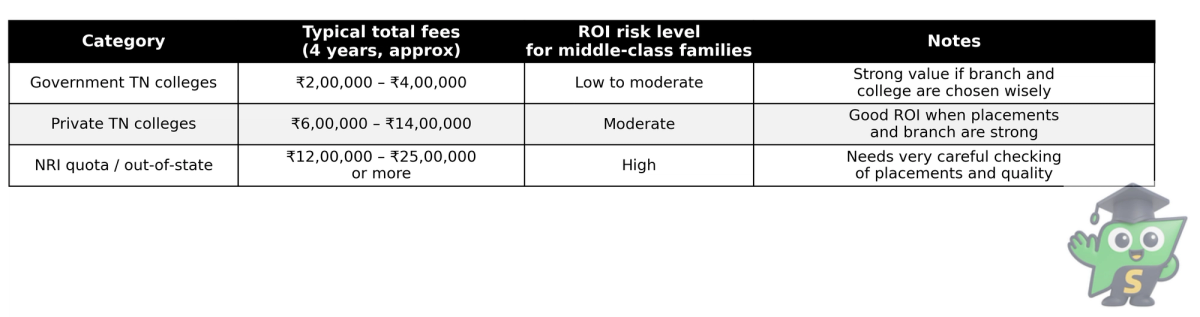
Fees include tuition, hostel, mess, transport, exam fees, and sometimes NRI quota or additional charges. In Tamil Nadu, government engineering colleges can cost just a few tens of thousands per year, while private and deemed universities, especially for branches like CSE, may charge 1–3 lakhs per year or more. First-generation graduates also benefit from Tamil Nadu’s fee concessions, reducing the burden.
ROI (Return on Investment) asks: “For the money and four years I put in, what kind of job, salary, growth, and stability can I expect?”
It’s not only about the first salary but also long-term growth, quality of placements, industry exposure, alumni network, and the flexibility to switch careers or do higher studies. Sometimes, a college with slightly higher fees but strong placement outcomes can offer much better ROI than a cheaper college with weak industry links.
How Tamil Nadu families usually think about fees
In many Tamil Nadu households, Parents naturally feel pressure because they balance EMIs, savings, siblings’ education, and household costs. When they hear that private colleges charge lakhs per year, fear sets in; when they hear government college fees, they wonder whether the quality and placements are adequate.
Students feel their own stress: guilt about costing too much, fear of disappointing parents, tension from comparisons with cousins who joined cheaper colleges but still got good jobs. This emotional mix makes it harder to think clearly, which is why having a structured method helps.
Government vs private vs NRI quota: the real difference
Government engineering colleges under TNEA have low tuition fees and moderate hostel costs, making them affordable and worry-free, especially for first-generation graduates. Private colleges charge ₹1-3 lakhs per year, especially for CSE, IT, and ECE, often highlighting infrastructure and industry ties. NRI quota colleges have separate, higher fee slabs and require NRI proof. The core question: What are we getting in return, and is it better than a lower-fee option?
How to think about ROI beyond just salary
Most students look only at "average package" for ROI. But this hides variation between branches, placement percentage, and job types. A better approach combines multiple factors: typical salary for your branch, placement percentage, which companies visit, and what roles are offered. A college where 80-90% of CSE students get software roles may offer stronger ROI than a college where only toppers get high salaries while many struggle. ROI also includes non-financial benefits like alumni networks, location advantage for internships, and chances to prepare for GATE, CAT, or MS abroad.
Simple example of comparing fees and ROI
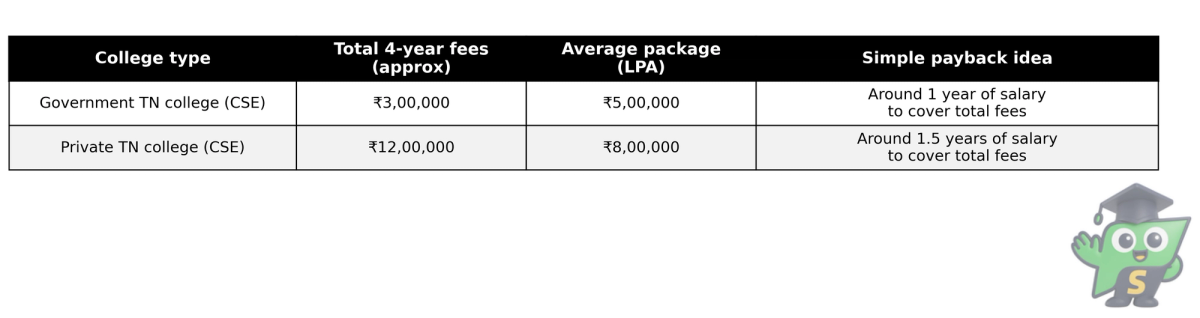
College A (government): ₹3 lakhs total fees, ₹5 LPA average CSE package. College B (private): ₹12 lakhs total fees, ₹8 LPA average package. College B looks attractive with higher salary and brand value. But consider ROI: a middle-class family needs to calculate loan EMI for ₹12 lakhs against that higher salary. With College A, lower fees and possible scholarships reduce stress, and the student has more freedom for higher studies or career risks. There is no one "correct" answer—the right choice depends on family finances, branch interest, and long-term plans.
Comparison of government and private Tamil Nadu engineering colleges
Why branch matters as much as college
A common mistake is focusing only on the college name and ignoring whether the branch truly matches your strengths. Today, CSE, IT, and certain ECE sub-fields offer strong placement opportunities, especially in software and product roles. Core branches like Mechanical, Civil, and Electrical require a different career journey—public sector exams, site work, or higher studies.
From an ROI perspective, joining a high-demand branch in a moderate college can be better than joining a brand-name college with a branch you dislike. Good outcomes in CSE placements India often come from consistent coding practice, projects, and internships—things you can build anywhere with proper guidance.
When NRI quota and outside‑state options make sense
NRI quota seats are often chosen to enter well-known campuses despite lower ranks. If the college truly has good placements, strong teaching, and a suitable branch, the higher fees may still be justified for some families.
But if the choice is driven only by “status” or pressure from relatives, and the college’s outcomes are average, the ROI becomes very weak. Many Tamil Nadu students do better by choosing a solid TNEA college over an expensive NRI quota seat.
Engineering College ROI Risk Analysis
Common mistakes students make while comparing
One of the most common mistakes is deciding only on “this college is famous” or “my friend is joining there”, without checking the real numbers for fees, hostel costs, and placements. Sometimes students only look at the highest package flashed on a poster or website, even though that may be for one or two students in CSE from top best engineering colleges India, while the average students may be getting much lower offers. This creates a false picture of ROI and leads to disappointment later.
Another mistake is ignoring hidden costs and scholarships. Some Tamil Nadu students forget to include travel, food, books, exam fees, and occasional extra charges when they mentally calculate “only tuition”. On the positive side, they may also miss out on schemes like first‑generation graduate tuition fee concessions, state scholarships, or minority/community‑based support that reduce the effective cost of certain colleges. A gentle correction here is to sit with a notebook, write down all possible costs for one year, and then multiply for four years, while also listing any scholarships you are eligible for, based on official guidelines and announcements.
How to gently correct your approach
If you feel like you already made some of these mistakes in your thinking, do not panic. This is the right time to pause, breathe, and reset your method. Instead of randomly checking many college websites and getting more confused, pick a smaller shortlist of colleges based on realistic cutoffs and your expected board or entrance scores. For Tamil Nadu students, that usually means focusing on TNEA colleges first, then looking at JEE Main or COMEDK options, depending on your interest and preparation level.
Once you have this shortlist, compare each college on three simple axes: total cost over four years, realistic placement outcomes for your chosen branch, and how strongly you feel connected to the branch itself. If needed, talk to seniors who studied there, but ask detailed questions about internship support, core vs IT job roles, and campus culture, not just “Is it good?” Over a few days, your mind will slowly shift from fear and FOMO to clarity, and you will start seeing which options truly offer better ROI for your situation.
How parents can support without adding pressure
One powerful way parents can support is by having open, calm discussions about money with the student, sharing a realistic picture of what the family can afford, what kind of loan is possible, and what sacrifices everyone is ready for together.
Parents can also focus on understanding ROI from a long‑term perspective instead of only chasing big names. When they encourage the child to choose a branch they enjoy and a college that fits the family’s budget, they send the message: “Your mental health and growth matter more than showing off a college name to relatives.” This reduces the child’s guilt and allows them to study with peace, which indirectly improves their performance and chances of better placements, no matter whether they join a government, private, or NRI quota college.
Where TNEA, JEE, and other exams fit into ROI
Entrance exams are powerful ways to improve ROI. Scoring well in board exams and using TNEA admissions smartly can get you into low-fee, high-value government colleges. Preparing for JEE Main also opens doors to NITs and IIITs, which may have higher fees but excellent placements and national-level exposure.
Should Tamil Nadu Students Write JEE?
Some students explore COMEDK or out-of-state options if they carefully weigh fees and ROI.
TNEA vs COMEDK
Entrance coaching time and costs must also be included in your calculations. When you see exams as opportunities rather than pressure, your preparation becomes more focused.
How to Manage Both Board Exams and JEE
Other Helpful Guides for Your Journey
Here are internal links you may want to explore next:
📌 How to judge placement quality
📌 How to compare fees and ROI
📌 What to ask during college campus visits
📌 Should students prefer tier two colleges with good placements
📌 How to compare private colleges
📌 NRI quota college selection
📌 How students can avoid marketing traps by colleges
📌 How to compare first year experience across colleges
📌 What makes a good engineering culture
How Prof Sam can stand beside you in this journey
Handling fees, ROI, branch decisions, and exam preparation during Class 12 can be overwhelming. A mentor who understands Tamil Nadu’s system—like Prof Sam—helps bring clarity. With personalised counseling, you can explore branches that fit your strengths, understand job market trends, and evaluate colleges based on realistic ROI.
Prof Sam also guides you on exam strategy across TNEA, JEE Main, COMEDK, and more, ensuring you don’t waste money or time on unnecessary attempts.
Complete Guide to Engineering Entrance Exams for Tamil Nadu Students
TNEA vs COMEDK
If you’re thinking about NIT/IIIT admissions or considering a drop year, you can evaluate fees, placements, and mental health implications calmly before deciding.
What rank is needed for NIT Trichy
How to decide if a student must attempt a drop year
The goal is simple: choose a path where fees are manageable, ROI is sensible, and you feel confident and supported—not pressured.
Need Personalized Guidance?
Book a consultation with Prof Sam and get expert advice tailored to your child's unique needs.
Book Your Consultation