

NRI quota college selection
Complete guide to NRI quota college selection for Tamil Nadu students. Learn eligibility, fees, top colleges, and how to choose wisely with Prof Sam's expert guidance.
You have worked hard for your Class 12 board exams. Your parents have made sacrifices, maybe even worked abroad to give you better opportunities. Now you are looking at college options, and someone has mentioned the NRI quota. You feel excited because this could be your pathway to a good engineering college. But you also feel confused. What exactly is NRI quota? How is it different from management quota? Which colleges accept it in Tamil Nadu? How much will it cost? Will the degree be worth it?
These questions are real and they matter. You are not alone in feeling this way. Thousands of Tamil Nadu students and their families face the same confusion every year. Let me walk you through everything you need to know about NRI quota college selection, so you can make a confident and informed choice.
What Exactly is NRI Quota and Who Can Apply
The NRI quota in private engineering colleges across India reserves seats for Non-Resident Indians, Persons of Indian Origin, and Overseas Citizens of India. Even students living in Tamil Nadu can apply if a close NRI relative—like a parent, sibling, grandparent, uncle, or first cousin—sponsors their education with valid documents and a notarized affidavit. Many assume this quota is only for those abroad, but that’s not true. If your parent works in Dubai or your uncle lives in the USA, you can still qualify. Eligibility usually requires passing Class 12 with Physics, Chemistry, and Math (minimum 45% for general category). Admission is often based on board marks, though some top colleges may also ask for JEE or TNEA rank.
How NRI Quota is Different from Management Quota
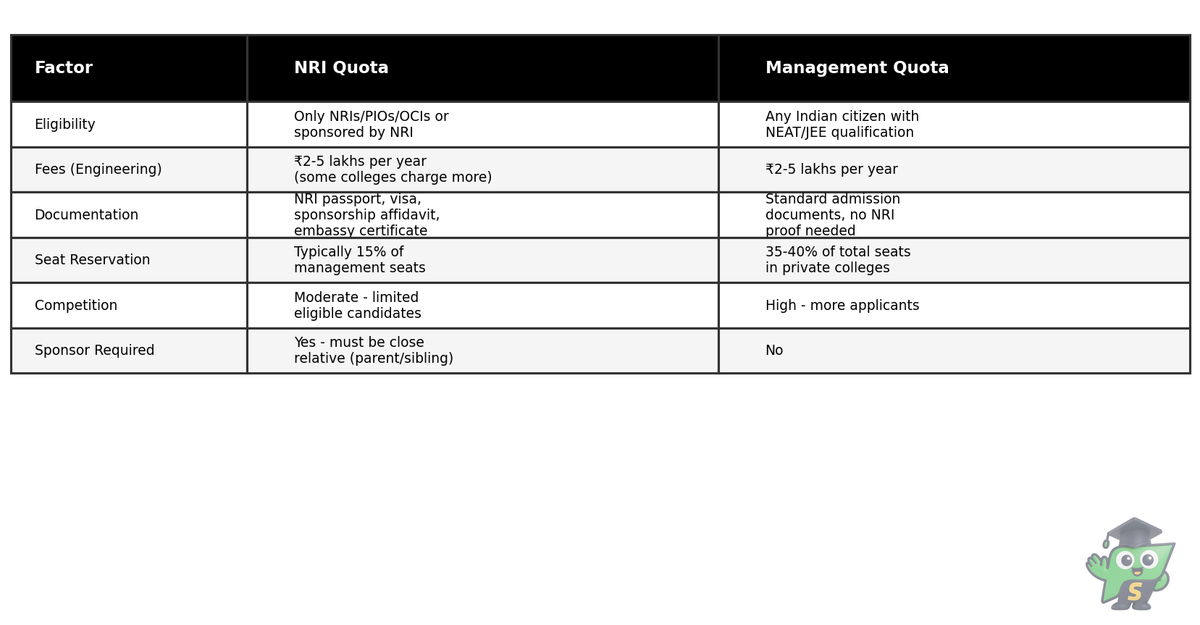
Management quota is a set of seats that private engineering colleges reserve outside the government counseling process. Any Indian student can apply for management quota seats if they have qualified entrance exams and are willing to pay higher fees. There is no requirement of having an NRI sponsor.
NRI quota, on the other hand, is a subset within the management quota structure. Colleges typically allocate about fifteen percent of their management seats specifically for NRI students. Only those students who can prove they are NRIs or are sponsored by an NRI can apply. The documentation is completely different. For management quota, you need standard academic certificates and identity proof. For NRI quota, you need NRI passport copies, visa documents, proof of residence abroad, embassy-issued NRI certificates, sponsorship affidavits, and relationship proof.
Another key difference is competition. Management quota attracts a large number of applicants because any Indian resident can apply, making it highly competitive. NRI quota has moderate competition because the pool of eligible candidates is limited. If you have genuine NRI documentation and meet academic criteria, your chances are better.
NRI Quota vs Management Quota Comparison
Key Factors When Choosing a College Under NRI Quota
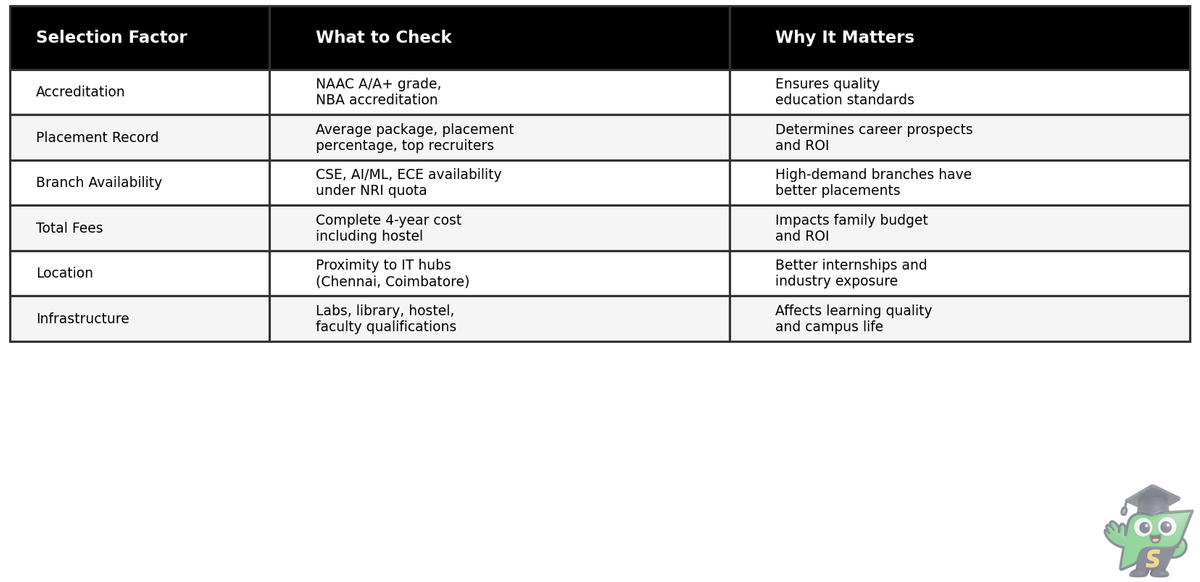
Choosing the right college shapes your skills, network, and career. When selecting a college under NRI quota, you need to look at several important factors.
First, check accreditation. Always choose a college with NAAC A or A+ grade and NBA accreditation for your chosen branch. This ensures the degree is recognized by employers, both in India and abroad.
Second, study placement records carefully. Do not just look at the highest package—focus on median and average packages. Check the placement percentage and which companies recruited. For Computer Science in top Tamil Nadu private colleges like VIT Vellore, the average package is around ₹7-8 lakhs per annum; SSN Chennai offers around ₹10 lakhs; SASTRA Thanjavur offers around ₹7.5 lakhs.
Third, choose your branch wisely. Computer Science Engineering, AI/ML, Electronics and Communication Engineering, and Information Technology have the best placement opportunities in Tamil Nadu. Do not just follow the crowd.
Fourth, consider total cost. NRI quota fees range from ₹2-24 lakhs per year depending on the college. Add hostel and other expenses; the total four-year cost can be ₹50-80 lakhs for premium colleges. Compare this with expected starting salary. College like PSG Tech or SSN Chennai offer lower fees with excellent placements, giving better return on investment.
Finally, check the location and infrastructure. Colleges near IT hubs like Chennai or Coimbatore have better industry connections and internship opportunities. Visit the campus if possible and talk to current students.
Key Factors for College Selection
Common Mistakes Students Make
Every year, many Tamil Nadu students make avoidable mistakes during NRI quota college selection.
The first mistake is not verifying eligibility properly. The sponsor must be a close relative with valid NRI status. Some students discover too late that their documents are not accepted. Always check eligibility criteria on the college website before applying.
The second mistake is incomplete documentation. NRI quota requires many documents like passport, visa, proof of residence abroad, embassy NRI certificate, sponsorship affidavit, and relationship proof. Many submit unattested photocopies or outdated certificates. Prepare a checklist, get everything attested, and double-check before submission.
The third mistake is missing deadlines. NRI quota admission happens on a rolling basis—some colleges start in May, some later. Students who delay often find only less preferred branches available.
The fourth mistake is focusing only on college name and ignoring branch and placements. Getting Civil Engineering in a top college might sound impressive, but if your interest is software and Civil placements are weak, you will regret it.
The fifth mistake is not calculating the total financial commitment. Many families do not calculate four-year costs including fees, hostel, books, and travel. They also do not compare this with expected salary after graduation. Sit down with your parents, calculate the full cost, check placement data, and assess the return on investment How to Manage Both Board Exams and JEE.
Finally, do not ignore other options. Some students put all hopes on NRI quota without preparing for TNEA, JEE Main, or other exams. Keep multiple options open Complete Guide to Engineering Entrance Exams for Tamil Nadu Students.
How Your Parents Can Support You
This decision feels overwhelming, but your parents can help you navigate it healthily. First, have open conversations without judgment. Listen to your thoughts about interests and career goals.
Second, help with research and documentation, but do not take over completely. This is your future, and you need to be involved.
Third, be realistic about finances. If paying ₹80 lakhs will put the family in debt, discuss it openly. Explore scholarships and affordable options together.
Fourth, do not compare your child with neighbors or relatives. Every student is different.
Finally, encourage professional guidance if needed. Career counselors like Prof Sam can provide personalized guidance on branch selection, college comparison, and entrance exam strategy.
Quick Reference – All Topics
📌 How to judge placement quality
📌 How to compare fees and ROI
📌 What to ask during college campus visits
📌 Should students prefer tier two colleges with good placements
📌 How to compare private colleges
📌 NRI quota college selection
📌 How students can avoid marketing traps by colleges
📌 How to compare first year experience across colleges
📌 What makes a good engineering culture
How Prof Sam Can Help You
Choosing the right college under NRI quota is about understanding your strengths and matching them with the right branch and college. Prof Sam brings twenty-five years of global hiring expertise and understands what employers look for in engineering graduates.
Prof Sam starts with careers, not courses. What kind of work do you enjoy? What are your strengths? Which industries are growing? Once these questions are answered, the right branch and college choices become clear.
Prof Sam provides personalized career counseling to identify your aptitude, data-driven college comparisons based on return on investment and placements, expert advice on studying in India versus abroad, help with JEE Main and TNEA strategy How to Manage Both Board Exams and JEE, Last 30 Days Before JEE Main, guidance on NIT and IIIT decisions What rank is needed for NIT Trichy and support with drop year decisions How to decide if a student must attempt a drop year.
Prof Sam facilitates unified family decisions that align everyone's expectations and reduce anxiety. Explore more resources on Prof Sam website about engineering entrance exams, college selection, and branch comparisons Should Tamil Nadu Students Write JEE? TNEA vs COMEDK .
You’re not alone in this journey.
If you want personalised guidance, book a session at:
Making Your Decision with Confidence
Take a deep breath. This decision is important but not the end of the world. Thousands of students go through this every year, and most do just fine. Your college and branch matter, but your effort, attitude, and skills matter more.
List all your options clearly. Which colleges are you eligible for? What are the fees? What are placement records? What branches are available? Write everything down to compare side by side. Involve your family in the discussion and seek professional help if needed. Trust yourself—if a particular college or branch feels right and makes sense financially, go for it.
Your engineering journey is just beginning. The college you choose is only the starting point. What truly matters is how you use the next four years to learn, grow, build skills, make connections, and prepare for your career. Work hard, stay curious, and believe in yourself. Success will follow.
Need Personalized Guidance?
Book a consultation with Prof Sam and get expert advice tailored to your child's unique needs.
Book Your Consultation