

How to compare private colleges
Learn how Tamil Nadu students and parents can calmly compare private engineering colleges using fees, ROI, placements, branch strength, and counseling support.
Choosing a private engineering college feels like the most serious decision of your teenage years. Your relatives, friends, and teachers all have different opinions, and each college promises "best placements" and "top rankings". You may feel scared of choosing wrong, worried that one decision will define your whole life. This pressure is completely normal, especially in Class 11 and 12 when you already juggle boards and entrance exams. This guide aims to make that confusion lighter by showing you how to compare colleges in a calm, practical way—understanding what really matters, what can be ignored, and how to involve your parents without conflict. Most importantly, you will realize that while marks and colleges are important, they do not define your worth as a human being.
Why comparing private colleges feels so confusing
If you are studying in Tamil Nadu, your college choice is almost never about a single exam. You are juggling board exams, TNEA plans, and doubts about whether to also write JEE Main or COMEDK and look at colleges outside the state. At the same time, your phone is flooded with lists of top private colleges, cutoffs and placement screenshots, and many campuses look impressive from outside while you still do not know what really happens in class or during placements.
Students and parents also see colleges very differently. You may focus on CSE placements India, coding culture, fests and Wi‑Fi, while your parents think more about safety, hostel comfort, distance, transport and total fees. Both views are valid, but without a common way to compare colleges, conversations easily become emotional, with one side speaking about “brand name” and the other about “cost”, and everyone feeling more confused. That is exactly why you need a simple, shared mental framework to guide your comparison.
The right mindset before you compare colleges
Before worrying about cutoffs, fees and placements, it helps to reset your mindset. Many students think only government colleges or one or two famous private colleges can give a good life, but that is not true; there are plenty of private colleges in India and Tamil Nadu that quietly offer strong placements in CSE, IT, ECE and similar branches, while some grand-looking campuses fail to provide good teaching or career support. The real goal is not to hunt for a “perfect” college, but to choose a place where four years of your life will be safe, productive and aligned with your goals. Marks and ranks decide which options are realistically open, not your worth as a person, and even if you miss a dream target like NIT Trichy, you can still build an excellent career from a good private college with focused effort What rank is needed for NIT Trichy.
Core factors you must check in private colleges
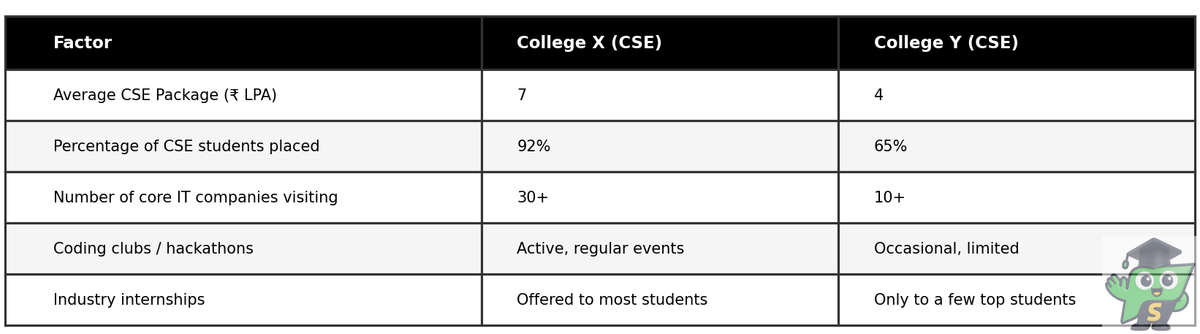
When you compare private colleges, you can think in terms of a few core pillars: academics, branch strength, placements, fees and overall environment. Academic quality is not just about “big buildings”. It is about whether faculty are qualified and engaged, whether labs are properly maintained, and whether the syllabus is updated to match industry needs. For example, a strong CSE department today will usually have content around data structures, algorithms, databases, networks and also newer areas like AI, data science or cloud computing.
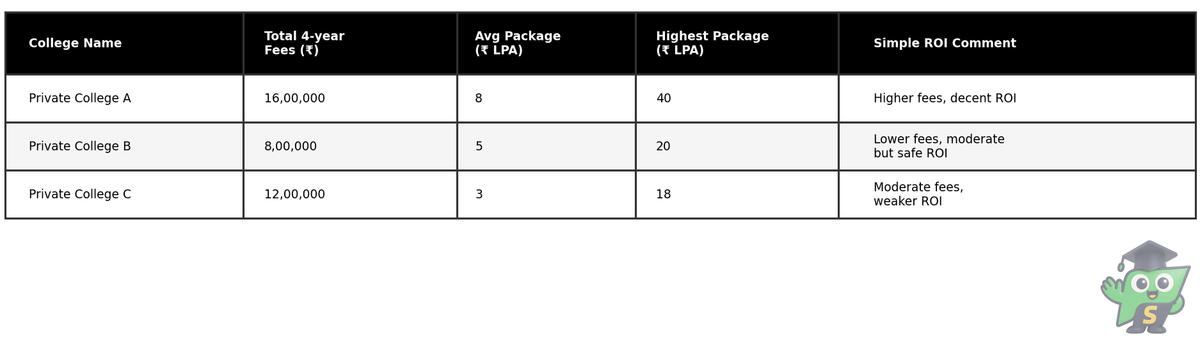
Placements should be seen in a balanced way. Do not be impressed only by one very high package written in bold on a poster. That might have gone to one student in a rare role. What matters more is the average and median package, how many students from your branch actually get placed, and what kind of companies visit regularly. For long-term private engineering colleges ROI, a steady set of decent offers for many students is usually more meaningful than one or two superstar stories.
Simple ROI comparison
Rankings, lists and local reputation
You will see many “top engineering colleges in Tamil Nadu” lists and “best engineering colleges India” rankings. Some use official data like NIRF ranks, fees and placements, and they can be a useful starting point to understand which colleges are generally considered strong. But these lists are not the full story. Just because one college is five or ten spots lower on a list does not always mean it is a bad choice for you, especially when you look at your particular branch and budget.
Local reputation also plays a big role. In each region of Tamil Nadu, employers and seniors know which private colleges consistently produce disciplined, skilled graduates. Listening to two or three honest seniors or teachers who know a college closely is often more helpful than reading dozens of anonymous comments. At the same time, you should remember that one person’s experience is still just one data point. Look for repeated patterns in what you hear, both good and bad, before you let it influence your final decision.
Branch choice, CSE craze and fit
Many students choose CSE or computer branches because of high salaries and job flexibility. That interest is valid, but ask yourself honestly: do you actually enjoy the work? Coding, debugging, and problem-solving on a screen for long hours excites some students and drains others. If you genuinely enjoy logic, maths, and tech, choosing a college with strong CSE placements and coding culture is smart.
But if your heart is in core engineering—Mechanical, Civil, EEE, or ECE—shift your comparison accordingly. Look for colleges with active labs, where students do projects, enter competitions, and intern at core companies. Sometimes it is smarter to choose a college less famous for CSE but very strong in your chosen branch than to force yourself into a trendy branch where you will not be happy.
Comparing two private colleges for CSE
NRI quota, management quota and special admissions
Many families explore NRI quota colleges or management quota seats when regular cutoffs are slightly out of reach. These paths usually mean higher fees, and sometimes different admission rules. It is easy to think, “If we pay more, the outcome will automatically be better,” but the reality is that you will still sit in the same classrooms and attend the same labs as everyone else. So, even if you use a special quota, you still must compare academic quality and placements the same way.
If you are thinking about colleges outside Tamil Nadu through JEE Main, COMEDK or private university exams, the comparison becomes wider. You will weigh better brand names or CSE placements India against distance from home, language comfort, climate, travel costs and hostel safety. There is nothing wrong in choosing a slightly less famous campus closer to home if that is what keeps you stable and healthy. Your career is a marathon, not a sprint; mental comfort also has value.
What actually happens during TNEA and other counsellings
In Tamil Nadu, many students enter engineering through TNEA based on board marks, while others also try JEE Main, COMEDK, or private entrance exams conducted by specific universities. TNEA vs COMEDK During TNEA counselling, you will see a long list of colleges and branches, and seats keep moving as each rank holder chooses. In that fast-moving screen, it is very easy to panic and pick a college just because “seats are going” or because a friend is choosing it.
Families often reach the counselling hall with an incomplete or emotionally driven list. Some parents get excited seeing that a higher “brand” college is still available and force a branch switch at the last minute, while some students insist on a dream branch in a very weak college without understanding the long-term impact. The best way to avoid this is to prepare a clear, realistic priority list before counselling starts, based on your marks, your branch preference, and the factors discussed in this blog. How to prepare for TNEA cut off based admissions
Common mistakes students make and gentle corrections
Students often choose colleges for the wrong reasons. One frequent mistake is picking a college just because a best friend is going there, even if the branch or environment does not suit you. It feels safe in the short term, but after a year or two, you may feel stuck. Another mistake is falling in love with campus photos on social media and ignoring questions like, “How strong is the teaching?”, “What are the placements like for my branch?” and “What is the actual workload?” You deserve nice infrastructure, but not at the cost of poor academics.
Many students also get carried away by big promises like “guaranteed placement” or “foreign internship for everyone”. No college can truly guarantee the future of every student. The gentle correction here is to look for evidence. Ask where students from that college are actually working, which companies visit every year, and what kind of roles are common. And remind yourself that your own habits matter more than any poster. Even in a good college, you will need consistency, curiosity and courage to build the life you want.
How parents can support this journey
The most powerful support parents can offer is calm, patient listening. When they ask what branch you truly like, and why certain colleges attract you, you feel respected. When you, in turn, listen carefully to their concerns about safety, fees and distance, they feel heard. Together, you can divide the work: you research branch and placements, they look into fees, scholarships and hostels. When the final decision is taken as a team, you carry much less emotional baggage into your first year.
Other Helpful Guides for Your Journey
📌 How to judge placement quality
📌 How to compare fees and ROI
📌 What to ask during college campus visits
📌 Should students prefer tier two colleges with good placements
📌 How to compare private colleges
📌 NRI quota college selection
📌 How students can avoid marketing traps by colleges
📌 How to compare first year experience across colleges
📌 What makes a good engineering culture
How Prof Sam can make this simpler
Even with all this understanding, it can still feel heavy to do everything alone. That is where a mentor like Prof Sam can be extremely helpful. Instead of generic advice, you receive one-to-one career counseling that focuses on your marks, your interests, your confusion and your family situation. You can talk openly about whether you should write JEE Main, how to treat COMEDK or other exams, which branches fit your personality, and how to think about NIT/IIIT versus strong private colleges.
Prof Sam’s guidance covers branch and college selection, JEE/TNEA/COMEDK strategy, NIT/IIIT decisions, and even honest conversations about whether a drop year is sensible for you. You get realistic college lists instead of random names, and clear explanations of private engineering colleges ROI for different options. With that support, comparing private colleges stops feeling like a lonely, risky bet and starts looking like a guided, step-by-step process. You realise you are not walking blind; you have a roadmap, a mentor and your family with you.
Book Your FREE Career Consultation – Limited slots available for personalized guidance.
Need Personalized Guidance?
Book a consultation with Prof Sam and get expert advice tailored to your child's unique needs.
Book Your Consultation