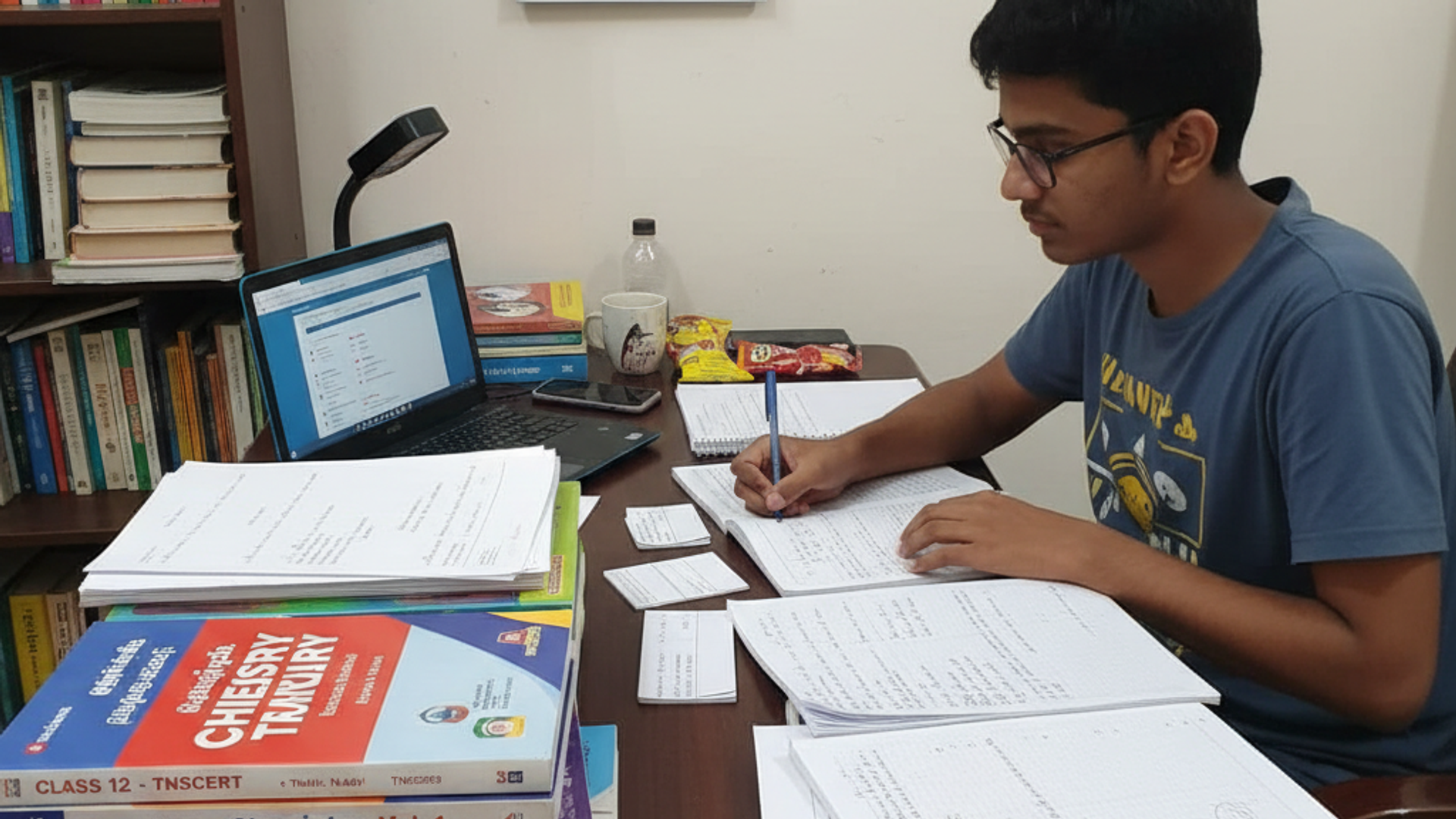
How to prepare for TNEA cut off based admissions
Master TNEA preparation with practical study plans, smart strategies, and expert tips. Learn how to score high in board exams and secure admission to top engineering colleges in Tamil Nadu.
If you’re planning to enter engineering through TNEA, you’re in a unique place. Unlike students in other states who juggle multiple entrance exams, mock tests, and coaching pressure, your entire future depends on one thing: how well you perform in your Class 12 board exams. No separate entrance test. No second attempt. Just you, your school syllabus, and your preparation.
That might sound simple, but you already know the truth. When everything depends on one set of exams, the pressure can feel intense. A few careless mistakes in your board exams can shift your TNEA rank drastically. But here’s the part most students forget — TNEA is actually one of the fairest admission systems. If you prepare with consistency and clarity, you can 100% get into a good college, even a dream one.
Let’s walk through it together, step by step, the way a mentor would guide you — not with complicated theory, but with clarity, honesty, and a solid strategy.
Understanding How TNEA Scoring Actually Works
Before anything else, you need to understand the system. Once this becomes clear, your preparation becomes simpler and more focused.
Your Class 12 marks are converted into a 200-mark TNEA score using this formula:
- Mathematics: 100 marks
- Physics: 50 marks
- Chemistry: 50 marks
And that’s it. No hidden weightage. No surprises.
What does this mean for you? Something very important: Mathematics is half your total score.
If your goal is to improve your TNEA rank, your most powerful subject is Math. Strong Math + decent Physics and Chemistry = excellent TNEA score. Even if Physics feels tough or Chemistry feels boring, strong math can pull your entire score upward.
On the other hand, if Math is weak, nothing else can fully compensate. And that’s exactly why your preparation should reflect the weightage.
Setting a Target That Actually Matches Your Goals
You can’t prepare blindly. You need a target. No one expects you to score magically without knowing what you're aiming for.
Here’s the honest breakdown:
- 190+ means CEG, PSG Tech, SSN — the top-tier.
- 180–190 means excellent Tier-2 colleges across Tamil Nadu.
- 170–180 means very good options with strong faculty and placements.
- 160–170 means you’ll still get solid colleges, but not the most competitive ones.
Most students dream of Tier-1 colleges — and that’s perfectly fine — but be realistic. If you’re currently scoring around 70% in school tests, you can definitely reach 85% with good preparation, but expecting 98% might create unnecessary pressure.
It’s absolutely okay to aim high. Just make sure your strategy matches your ambition.
Your Three-Phase Preparation Strategy (The Mentor-Approved Path)
This is the same strategy I recommend to every student who asks, “How do I study effectively for TNEA?” It’s simple, practical, and works for students of all levels.
Phase 1: Build Your Foundation (Class 11)
Think of Class 11 as the time you lay the bricks. The wall you build in Class 12 will only be strong if the bricks are solid.
Don’t rush through topics. Understand them deeply. Read your NCERTs patiently, write your own notes, and get comfortable with basic problem solving. Many students ignore Class 11 thinking Class 12 is what “actually matters.” Ironically, Class 11 is what decides how easy or difficult Class 12 becomes.
If you truly understand functions, derivatives, vectors, mechanics, and moles from Class 11, Class 12 will feel smooth — not stressful.
Phase 2: Master the Syllabus (Class 12 – Mid Year)
This is where things intensify. You’ll have more lessons, more problems, and more expectations. But if you’re structured, it becomes manageable.
This is the phase where you complete every chapter fully and begin practicing regularly. If there’s ever a time to strengthen weak spots, it’s now. Students who panic in February or March panicked because they ignored their weaknesses in this phase.
Take tests weekly. Make a mistakes notebook. Ask doubts early. Don’t postpone topics you find difficult — those are exactly the topics that pull down your final score later.
Phase 3: Become Exam-Ready (Last 3–4 Months Before Boards)
By the time November or December arrives, you should stop learning new chapters.
Now, your mission is simple:
- Revise
- Practice
- Solve past papers
- Improve presentation
- Learn how the board exam wants answers
This final phase is often where students see a huge jump in marks — even 20–30% improvement - simply because they finally learn how to write answers properly and efficiently.
Subject-Wise Guidance: How to Study What Actually Matters
Every subject demands a different style. When you study the right way, even your toughest subject becomes manageable.
Mathematics — Your Power Subject
Math decides your TNEA fate more than anything else. Work on:
- Algebra
- Calculus
- Coordinate geometry
- Trigonometry
- Statistics and probability
The truth? Math rewards practice more than intelligence. Even if you’re not “naturally good,” you can score very high through consistency.
Physics — Understanding Over Memorization
Physics becomes easier the moment you start understanding concepts visually. Draw diagrams. Use real examples. Think about how things work in real life.
Students who rely only on formulas struggle. Students who understand concepts succeed.
Chemistry — The Mix of Memory and Logic
Inorganic requires memorization. Organic requires pattern recognition. Physical requires formulas and numericals. Break it down. Don’t treat all chapters the same way.
When you understand how to approach each part of Chemistry, scoring becomes easy.
The Art of Writing Perfect Board Exam Answers
You can know a concept perfectly and still lose marks because your answer was not structured well. Examiners love clarity.
A simple approach:
- 1-mark answers: one line
- 2-3 mark answers: short explanation
- 5 mark answers:
- brief intro
- step-by-step solution
- diagram if applicable
- final conclusion
When you write answers in a logical flow, you naturally score more.
A Study Schedule That Actually Works
Forget impossible timetables that look perfect on paper but collapse in two days. Your study plan needs to feel natural.
In Class 11, two to three hours daily is more than enough.
In early Class 12, you’ll need three to four hours.
In the last few months, five to six hours including revision and practice.
Weekends are your strength — use them for revision and solving past papers.
Remember: slow and steady consistency always beats random bursts of long study hours.
The Mistakes That Stop Students From Scoring High
Almost every TNEA aspirant makes the same mistakes. The good news? Once you’re aware of them, they’re easy to avoid.
Students underestimate Math, skip tough topics, memorize instead of understanding, revise too late, avoid practice tests, or depend too much on coaching without studying on their own.
Awareness is half the solution. Challenge these habits and you immediately improve your score.
Choosing the Right Resources Without Getting Lost
You don’t need 20 textbooks. You need clarity.
NCERTs are your backbone. Past papers are essential. A couple of reference books for Physics and Math help. And if coaching works for you, take it — but remember, coaching is a tool, not the solution. Self-study is the real driver.
Your Final 3 Months: Where Everything Comes Together
This is where your preparation transforms into results. These three months decide your TNEA score.
Revise every chapter. Solve past papers daily. Take timed tests. Understand your mistakes. Fix them. Repeat.
The students who improve rapidly in these months are not the ones who study the most — they’re the ones who study smart.
The Mindset That Makes You Win
Here’s what I want you to remember:
You don’t need to be extraordinary. You just need to be consistent.
Board exams are predictable. If you prepare well, you score well. TNEA is not luck-based. It is not about competing with geniuses. It is simply about being reliable and disciplined every single day.
And you are absolutely capable of that.
Why Career Guidance Matters — Even With a Great TNEA Score
After TNEA results, you face decisions that affect your next four years — and your career.
Which college should you choose?
Which branch suits you?
Is engineering actually right for your interests?
Should you also consider JEE?
A high score is great — but choosing the wrong college or branch can still lead to regret.
That’s why Prof Sam’s Career Consulting exists. With 25+ years of hiring experience, the goal isn’t just to help you choose a college — it’s to help you choose the right path.
If you want personal guidance for your TNEA plan, your college list, or your branch selection, you can book a session at:
Sometimes, one conversation can save you years of confusion.
Quick Links to Related Topics
📌 Should Tamil Nadu Students Write JEE?
📌 TNEA vs COMEDK Comparison
📌 Top Colleges Accepting JEE
📌 TNEA Preparation Strategy
📌 JEE 30-Days Plan
📌 Balance Board & JEE
📌 Common JEE Mistakes
📌 NIT Trichy Requirements
📌 JEE Coaching Selection TN
📌 Drop Year Decision
Final Words
Preparing for TNEA isn’t about being perfect. It’s about being committed. If you build strong fundamentals, give your best in Class 12, revise well, and stay honest with yourself, you can absolutely secure a strong TNEA score — one that opens doors to excellent colleges.
Strengthen your Class 12 fundamentals on ScoreLab
Free video lessons, revision notes, formula sheets, and past-paper MCQs for CBSE Class 12.
Need Personalized Guidance?
Book a consultation with Prof Sam and get expert advice tailored to your child's unique needs.
Book Your Consultation