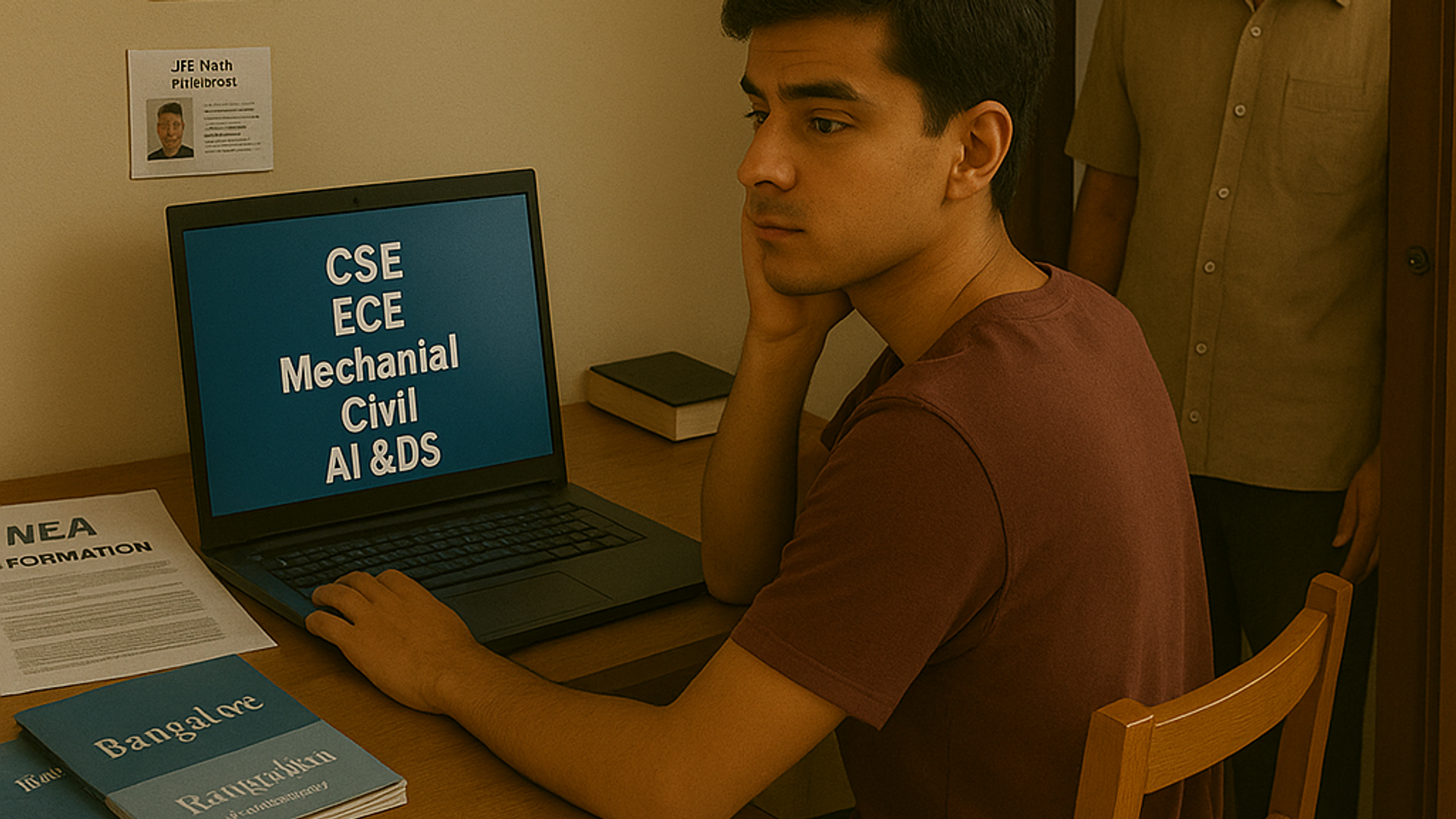
Common mistakes students make while choosing branches
Tamil Nadu mentor Prof Sam explains common mistakes students make while choosing engineering branches and shows how to choose calmly, wisely, and confidently.
Choosing an engineering branch is not just a formality in TNEA choice filling or JEE/COMEDK counselling. It shapes what you will study every day for four years, the skills you build, the opportunities you open, and even how you feel about yourself in college. Many Tamil Nadu students go through this decision in a hurry, surrounded by pressure, confusion and incomplete information. It’s normal to wonder, “What if I choose wrong? What if I regret it?” These doubts deserve patience, not judgement. This article speaks to you like a senior mentor, slowing you down and guiding you with clarity so that you and your parents can choose with confidence instead of fear.
The Tamil Nadu reality: how branch decisions actually happen
For most students here, the journey feels predictable: finish Class 12, apply for TNEA, attempt JEE Main or COMEDK if needed, and hope for a “good college with a good branch”. But in reality, decisions often take place in the chaos of last-minute counselling. Advice comes from all directions — relatives insisting that CSE is the safest bet, others saying a government college is always better than any private option, and friends forwarding generic lists of “top branches”. Students see cutoffs of CEG, PSG, SSN and quickly feel discouraged. Meanwhile, many don’t fully understand what each branch actually teaches. Parents carry their own anxieties about job security and stability, and although their intentions are full of love, they may not always know the difference between closely related branches like ECE, EEE, Mechatronics or AI-based programs. That’s how avoidable mistakes begin.
Mistake 1: Choosing only by trend and salary
One of the biggest traps is choosing a branch simply because it’s trending. For years, IT and CSE dominated conversations; now AI & Data Science, Cyber Security and similar labels attract attention. While it’s true that some branches currently have strong demand and great placements in top colleges, blindly chasing trends can backfire. Salary depends on college quality, personal skill, internships, communication strength and long-term effort. A student who hates coding might suffer through four years of CSE. Someone fascinated by machines may feel suffocated in a purely software-centric branch. Instead of asking which branch pays more, ask yourself which branch will keep you motivated to work hard consistently. Skill plus interest creates stability, not fancy names.
Mistake 2: Ignoring your own aptitude and comfort with subjects
Many students push through PCM in school because engineering feels like the default path. But within these subjects, your natural preferences matter. Some students enjoy math and logic, some connect with physics, some dislike circuits, and others find programming stressful. Ignoring these signals during counselling can make college life much harder. A branch heavy in mathematics or coding may overwhelm someone who has always struggled in that area. A theory-centric branch may drain a student who thrives through hands-on learning. Paying attention to your experiences from Classes 9–12 gives useful clues. In Prof Sam’s counselling sessions, students explore their strengths, challenges, and learning patterns — not to label themselves, but to find a path that feels achievable and meaningful.
Mistake 3: Confusing college name and branch importance
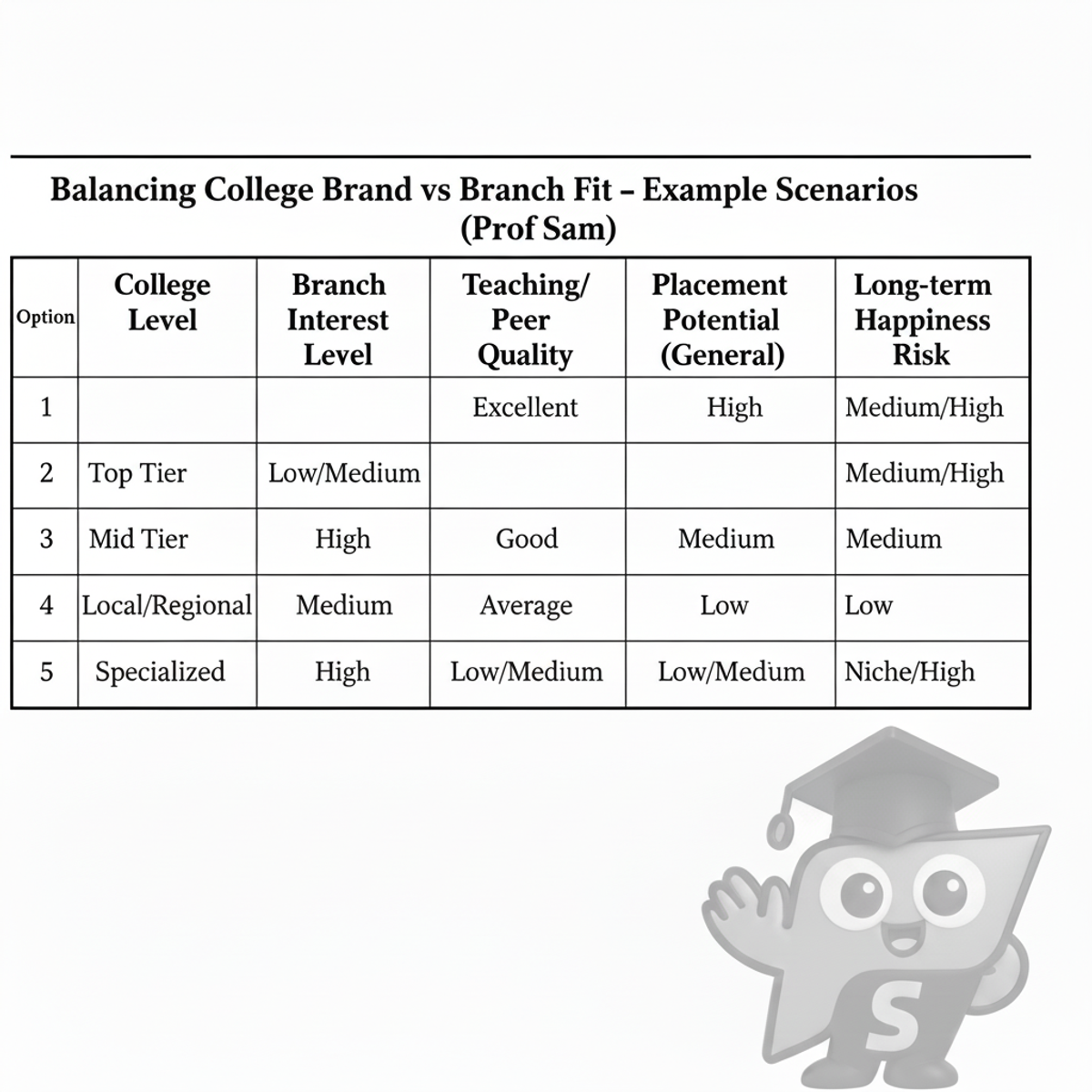
One of the most debated dilemmas is whether to choose a top-tier college with an average branch or a smaller college offering the branch you truly prefer. TNEA has more than 400 colleges, and many students also look at NIT Trichy, IIITs and COMEDK colleges. Both college reputation and branch fit are important. A strong branch in a mid-level college may be better than a mismatched branch in a top institution if it aligns with your strengths. On the other hand, joining a poorly run college just to get a trending branch can limit learning, exposure and placements. Instead of rushing during counselling, it helps to calmly compare how different combinations — college quality vs branch fit — might impact your four-year experience and future opportunities.
Balancing College Brand vs Branch Fit
Mistake 4: Not understanding what each branch actually teaches
Many students choose ECE, EEE, Mechanical, Civil, CSE, IT, AI & DS, Mechatronics or Biotechnology without reading a syllabus or speaking to actual students. Assumptions like “ECE is safe because it covers everything” or “Mechanical means only factories” are misleading. Each branch has a specific mix of theory, lab work, coding, design, circuits and applied concepts. Students often feel shocked in the second year when core subjects begin, realising too late that the branch doesn’t match their interests. Reading simple, clear overviews of branch content and job roles before counselling can make a huge difference. In Prof Sam’s sessions, students explore the daily life of people in different branches and understand what the next four years will actually look like — far more meaningful than just choosing based on three-letter abbreviations. For deeper reading later, the editor can link to guides like Complete Guide to Engineering Entrance Exams for Tamil Nadu Students.
Mistake 5: Ignoring multiple pathways like TNEA, JEE Main, and COMEDK
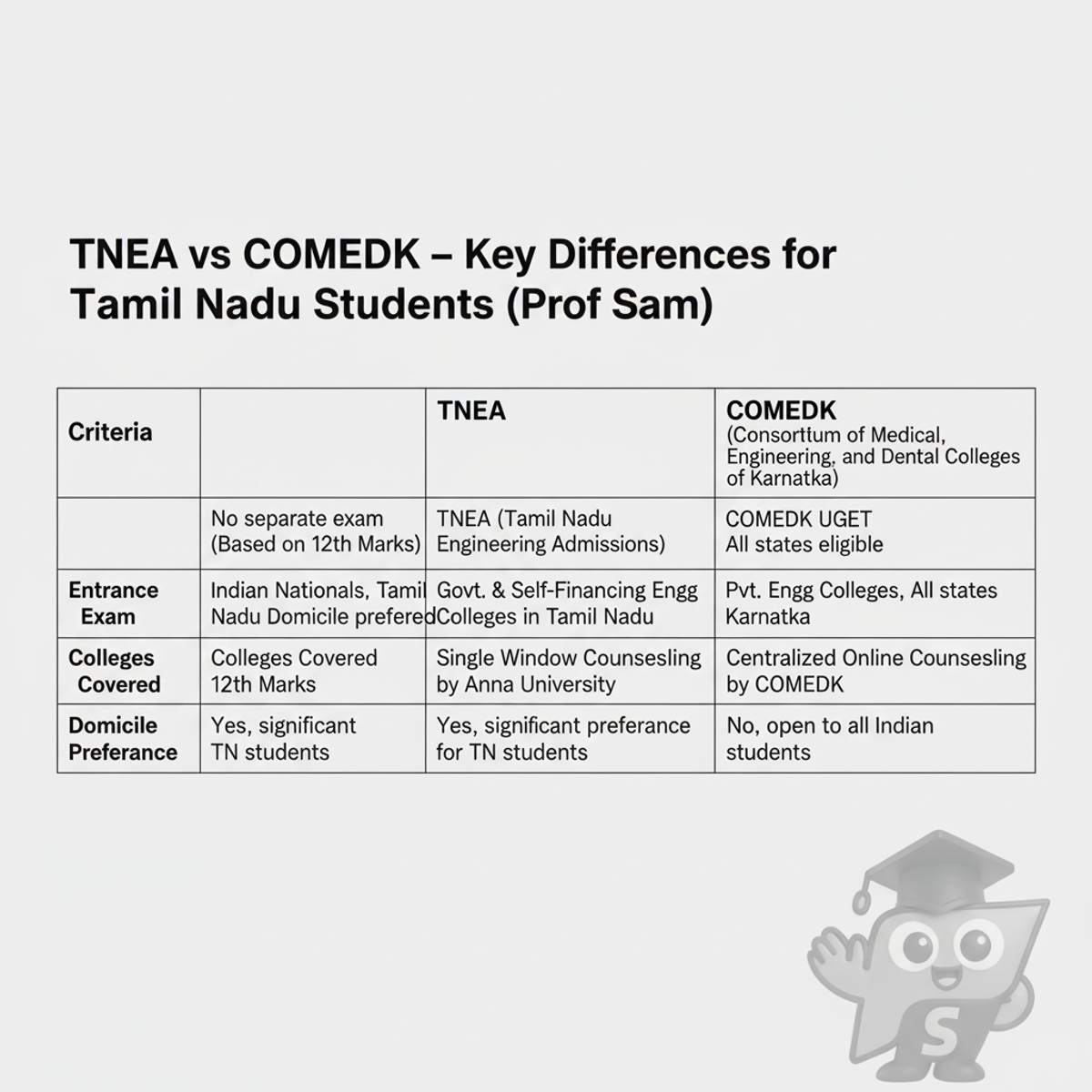
Many Tamil Nadu students assume there is only one correct path — either TNEA alone or JEE Main alone. Some think of COMEDK only at the last minute. In reality, keeping two or three paths open can expand choices significantly. A student preparing reasonably well for JEE Main can aim for NIT Trichy or IIITs while still using TNEA as a reliable backup. Combining TNEA with COMEDK also opens possibilities in Bengaluru. Understanding what each path demands, what colleges it offers, and how it fits your situation prevents panic decisions. A comparison table of TNEA vs COMEDK from a Tamil Nadu student’s perspective can be especially helpful. Articles like Should Tamil Nadu Students Write JEE?, TNEA vs COMEDK , and Colleges in Tamil Nadu that Accept JEE Main will support this further.
TNEA vs COMEDK
Mistake 6: Not matching your effort level to your target
Ambition is good, but ambition without a realistic plan creates disappointment. Wanting NIT Trichy CSE requires exceptional JEE Main performance. Top TNEA colleges like CEG, PSG Tech and SSN have very high cutoffs. Understanding the typical marks or percentiles for your target colleges gives clarity and helps you align your daily study habits. Guides like What rank is needed for NIT Trichy , Last 30 Days Before JEE Main, and How to Manage Both Board Exams and JEE help bring structure and practicality to this planning.
Mistake 7: Taking decisions only on relatives’ and WhatsApp advice
In many Tamil families, engineering counselling becomes a group activity. Uncles, cousins, neighbours, everyone wants to “help”. Some of that help is genuinely useful, especially from people who work in relevant industries. But often, the loudest voice wins, not the most informed voice. Outdated opinions like “Mechanical has no scope now” or “Civil is dead” or “Only IT gives jobs” keep circulating, even though the actual job market is more nuanced and depends on skills, location, and economic cycles.
When you listen only to such group advice, your own voice goes silent. You may say “I like electronics” but finally end up in a different branch because someone convinced your parents in a ten‑minute phone call. A healthier approach is to collect information from multiple sources, including official college websites, NIRF rankings, placement reports, and neutral experts, and then sit quietly with your parents and discuss what fits you. Articles like Common JEE mistakes Tamil Nadu students make and Complete Guide to Engineering Entrance Exams for Tamil Nadu Students can support that discussion.
Prof Sam’s sessions are designed to cut through this noise. They do not disrespect family opinions, but they add data, clarity, and a structured way of thinking. That way, when a relative suggests something, you can politely ask, “Can we check what the syllabus and placements say for that option?”
Mistake 8: Forgetting mental health and overall college environment
Many decisions revolve only around placements and branch scope. But your daily life matters too — distance from home, hostel comfort, campus culture, strictness, availability of clubs, sports and supportive faculty. A tiring commute or an unhealthy environment can drain motivation, regardless of branch quality. It’s okay to consider whether you can handle being away from home, whether you need a friendly campus, or whether the culture aligns with your personality. Your wellbeing is not a small factor; it is central to your success.
How to gently correct these mistakes
If these points feel familiar, it’s not too late. Start by writing down what you genuinely enjoy — building things, solving problems, coding, designing, understanding circuits, or working with machines. Then look at the branches you’re considering and reflect on how well they match your interests. Spend a few hours exploring syllabi from official college websites. Notice how you feel — curious, overwhelmed, or excited. That emotional response is important. Try talking to seniors or professionals from different fields to learn what their work day actually looks like. If confusion remains, a structured session with Prof Sam can help you create a personalised, practical plan based on your marks, strengths, exam choices and family situation.
How parents can support better branch decisions
Parents carry a heavy emotional and financial responsibility. Their intentions come from love, but sometimes children feel pressured. A more supportive approach is to first listen to the student’s interests and fears, then analyse data together without judgement. Instead of dismissing a branch, parents can ask, “Shall we check the syllabus and placements?” Neutral expert guidance, like Prof Sam’s counselling, can reduce stress at home and create a peaceful decision-making environment. For bigger choices like whether to take a drop year, the upcoming guide How to decide if a student must attempt a drop year will help families think clearly.
Other Helpful Guides for Your Journey
Here are internal links you may want to explore next:
📌 Signs that a student is suited for CS
📌 Mechanical engineering for the future
📌 How to decide between AI ML and core CS
📌 Common mistakes students make while choosing branches
📌 Which branch fits introverts
📌 Which branch fits creative students
📌 Which engineering branch gives the best work-life balance
📌 Branch myths students should ignore
📌 How to compare branch scope in India vs abroad
Where Prof Sam fits into your journey
Prof Sam exists to support Tamil Nadu students at this exact crossroads of exams, counselling and branch selection. Through one-to-one sessions, detailed branch–college mapping, and strategy discussions for TNEA, JEE Main and COMEDK, you receive a clear action plan instead of scattered advice. You can compare options like NIT Trichy vs top private colleges using facts, not fear. For those considering a drop year, the discussion is holistic, covering studies, mental health, finances and realistic outcomes. As new blogs like Complete Guide to Engineering Entrance Exams for Tamil Nadu Students, Should Tamil Nadu Students Write JEE?, TNEA vs COMEDK, and How to decide if a student must attempt a drop year go live, they will act as your knowledge base while counselling helps you build a personalised roadmap. Above all, remember that marks and rank matter, but they are not your identity. You deserve a branch and a college that match your reality, your ambitions and your wellbeing.
Strengthen your Class 12 fundamentals on ScoreLab
Free video lessons, revision notes, formula sheets, and past-paper MCQs for CBSE Class 12.
Need Personalized Guidance?
Book a consultation with Prof Sam and get expert advice tailored to your child's unique needs.
Book Your Consultation