
Branch myths students should ignore
Debunk branch myths holding back Tamil Nadu students. Learn why CSE isn't the only path, how placements work, and how to choose wisely for your future.
When you sit down to choose an engineering branch after Class 12, the advice floods in. Your parents worry. Your friends compare cutoffs. Relatives tell stories about placements. Coaching centers push Computer Science like it's the only path to success. Social media shows software engineer salaries that seem impossibly high. And somewhere in all that noise, you start believing things about engineering branches that simply aren't true.
The truth is: most of what you hear about engineering branches is either outdated, exaggerated, or irrelevant to your actual future. This blog is written for you—the Tamil Nadu student feeling lost in this maze. Let me help you separate fact from fiction.
Myth 1: "CSE Is the Only Branch That Gets Good Placements"
This myth is the loudest. But the reality is different. Yes, Computer Science has high placement rates. But so do Electronics and Communication Engineering (ECE), Electrical Engineering (EE), and Mechanical Engineering at good colleges. At NIT Trichy, CSE had a 96.9% placement rate in 2024, but ECE achieved 87.7%, EEE reached 92.9%, and Mechanical hit 90.6%. That's not "bad"—that's solid. The real problem isn't the branch. It's you. If you're in any branch and you don't develop skills, don't do internships, and don't network, you won't get placed well. A Civil Engineering student who learns BIM software and builds projects will have better prospects than a lazy CSE student who coasted through college just because "CSE gets jobs."
Why this myth exists: IT companies hire in bulk from all branches. They test logical thinking, not your branch knowledge. When hundreds of CSE students get placed in IT, it looks like CSE is magical. But many ECE and Mechanical students also get placed, just fewer bother to apply because of this myth.
Myth 2: "You Must Take CSE Even If You Hate Coding"
This myth causes real damage. Parents force children into Computer Science for "the money." Students spend four years miserable, resenting every programming class. Then they graduate hating their career. Here's what happens: If you dislike coding, forcing yourself into CSE leads to two bad outcomes. First, you'll struggle with Data Structures, Algorithms, and Operating Systems. Second, even if you pass, you'll end up in a job you hate. No salary compensates for that misery.
Meanwhile, if you love how things physically work—circuits, machines, structures—then ECE, Mechanical, or Civil might be better. Yes, starting salary might be ₹4-6 LPA instead of ₹8-10 LPA. But starting in a field you enjoy beats starting in a field that drains your soul. Real talk: Salary matters for security. But job satisfaction and the ability to not dread work matter more long-term. Choose based on genuine interest, not just salary spreadsheets.
Myth 3: "Lower Branch at a Top College Beats Higher Branch at a Lower College"
This one trips up even smart students. Should you take Mechanical at NIT Trichy, or CSE at a private college? The answer is: it depends, and there's no universal winner. A tier-1 college brand (NIT Trichy, IIT Madras, IIIT-H) opens doors that tier-2 colleges can't. Recruiters visit campus specifically for those institutes. Even in a "lower" branch at an NIT, you'll have decent placement options. A Mechanical student from NIT Trichy will get call-ups companies skip for CSE students from lower-ranked colleges.
But here's the catch: If you're in a branch you hate at a top college, you'll underperform compared to someone passionate about their branch at a mid-tier college. Your grades will suffer. Your enthusiasm for projects will be low. The passionate ECE student at a decent private college with 7-8 CGPA and solid projects might land a better role than you. The realistic framework: At top-5 NITs, the branch matters less—the college carries you. At lower tiers, pick the branch you care about at the college with better infrastructure. Your skills matter more than the brand difference.
Myth 4: "Core Engineering Knowledge Is Useless in Real Jobs"
Many students hear this and think their Mechanical or Civil degree is worthless. This crushes confidence before they even graduate. The reality is layered. Yes, many core students end up in software roles—because IT jobs are abundant. But that's a choice, not a default. Core knowledge becomes invaluable in specialized roles. A mechanical engineer with CAD and FEA expertise can work in automotive design or aerospace earning ₹15-25 LPA. An ECE graduate with VLSI or embedded systems knowledge earns ₹15-20 LPA in specialized tech companies. A civil engineer with smart city or sustainable architecture knowledge is increasingly in demand.
The problem: Most students don't know where to use their knowledge, so they default to software jobs. If you choose a core branch, plan to either specialize deeply in your field or deliberately learn coding to stay versatile.
Myth 5: "Your CGPA and Branch Determine Your Entire Career"
This belief is paralyzing—and mostly false. Companies look at CGPA, but it's not the only thing. It matters for initial shortlists at top companies. But what matters more: Skills: Can you code? Can you design? Can you solve problems? Internships and projects: What have you actually built? Networks and referrals: Do you know someone at a company?
A student with 7.0 CGPA and three solid internships beats a 9.0 CGPA student who did nothing. A student with a GitHub portfolio gets calls from startups with a 6.5 CGPA. Off-campus placements don't care much about CGPA. After your first year, experience and skills dominate. A 2025 graduate with 3 years of work history is judged on their career, not college marks from 2021. Real talk: Aim for 7+ CGPA. But don't believe it's a life sentence if it's lower. Build skills alongside marks.
Myth 6: "You Must Get Your Branch Choice on First Attempt"
In TNEA counseling, there's pressure: If I don't get CSE now, I've failed. Some students consider drop years because they got ECE instead of CSE. Stop. This myth is costing talented students an entire year. You're 18 years old. You haven't worked an engineering job. Changing your mind later—or realizing another branch is better—is completely normal.
Real examples: Many ECE students discover they love IoT and embedded systems. Mechanical students find passion in robotics. Civil students realize their branch is increasingly relevant. Some CSE students, after boring first-year theory, wish they'd studied ECE. Within colleges like NIT Trichy, branch change is possible after first year based on performance. You don't need to drop out. You don't need to start over. Drop years only make sense: If you're aiming for IIT-JEE and missed badly, or want to improve TNEA scores significantly. Not because you got ECE instead of CSE.
Understanding TNEA Cutoffs vs. Real Placement Reality
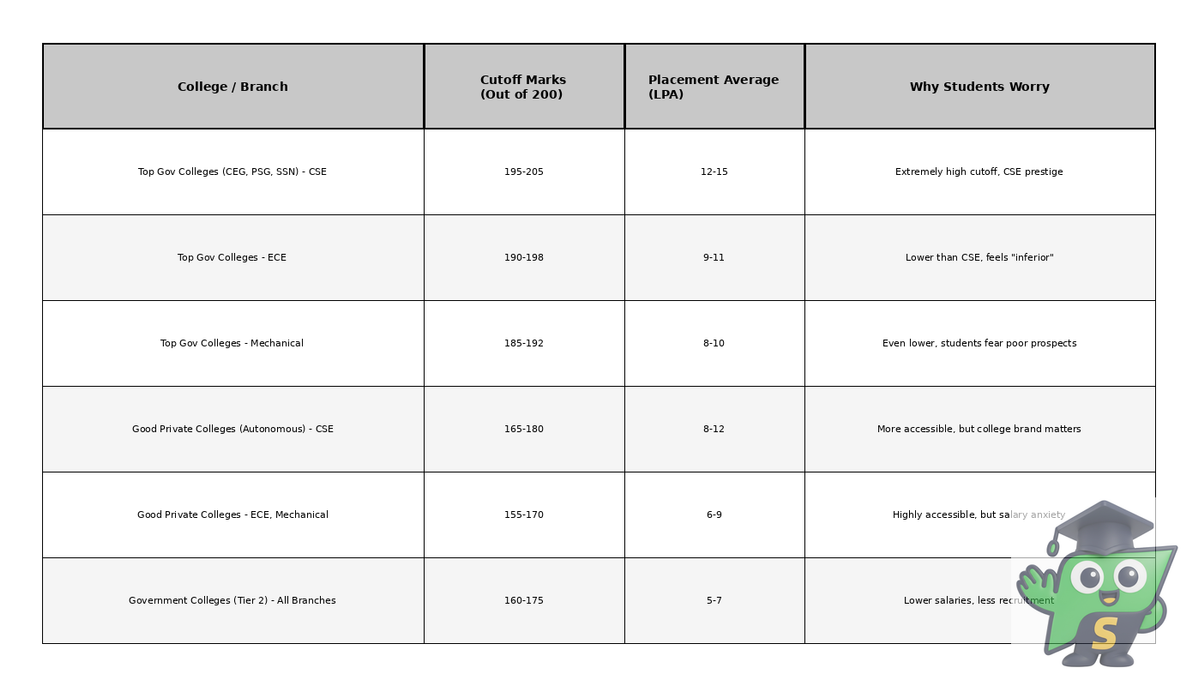
To help you understand how cutoff scores actually map to colleges and placements, here's what you should know. The table below shows real cutoff marks for top TNEA colleges across different branches, alongside their placement averages. What this reveals is powerful: a student with a 175 cutoff can get into good private colleges across multiple branches. You don't need to chase an impossible 205 cutoff for CSE at a top college when Mechanical at a good private college offers solid placements of 8-10 LPA. This destroys the myth that you must get a specific branch at a specific college to succeed.
TNEA Cutoff Reality vs. Perception
Common Mistakes Students Make
Mistake 1: Choosing Based on Cutoff Alone — Students think: I scored 185, so I can only do ECE. They don't ask: Do I actually want ECE? Fix: Understand each branch before counseling. Talk to seniors. Then match your score to the right branch for YOU, not just the easiest option available.
Mistake 2: Ignoring College Rankings for "Lower" Branches — College rank and infrastructure matter more than branch for your first job. Fix: Check NIRF rankings, faculty expertise, lab facilities, and placement stats—not just branch prestige. A tier-1 college in any branch will give you more opportunities than a tier-3 college even in your dream branch.
Mistake 3: Not Preparing Backup Plans — Students get so focused on one branch they panic when they don't get it. Fix: List 3-4 branches you could live with. Have a concrete plan for each. This removes shock and builds confidence. Mentally prepare for any outcome so you're not caught off-guard during counseling.
Mistake 4: Believing Branch Determines Your Entire Path — A student thinks: If I choose Mechanical, I'm stuck doing factory work. Or: Without CSE, I can't work in startups. Fix: Most students don't work in their branch specialization initially. Many work in IT, consulting, or analytics regardless of their branch. Your branch is your foundation, not your prison. It gives you technical depth, but your career path depends on what you build.
How Parents Can Support This Decision
Parents, your role in this moment is critical. What helps: Listen first. Ask what genuinely interests your child, then have a real conversation. Research colleges and branches using official sources—NIRF rankings, placement statistics, alumni feedback—not just neighbors' gossip. Reduce pressure. Statements like "You must get CSE or fail" create anxiety that hurts performance. Instead say: "We believe in you. Whatever branch you get, you'll succeed because you'll work hard." Plan for flexibility. If they don't get their preferred branch, help them see opportunities instead of making them feel they've failed.
What doesn't help: Comparing to neighbors' children. Assuming one branch guarantees success and another guarantees failure. Forcing a branch your child isn't interested in, just for prestige. Believing myths without researching current data. The key thing: Even in "lower" branches at good colleges, placements are decent. Your child's skills, motivation, and willingness to learn matter far more than the branch name. Support the choice—even if it's not CSE—and help your child succeed in it.
Making Your Final Decision
Step 1: Understand yourself. What genuinely interests you? Circuits and electronics? Code and algorithms? Machines and mechanisms? Buildings and infrastructure? If unsure, choose based on college reputation and faculty. Step 2: Research the college deeply. Check NIRF rankings, placement stats, faculty expertise, and alumni feedback. Step 3: Make a priority list. Order your branch choices realistically based on your likely score. Step 4: Prepare mentally for multiple outcomes. Whatever you get, you'll succeed if you work hard. Step 5: Plan around skill development. Learn basics in year one, then decide: specialize deep in your field or add complementary skills like coding?
How Prof Sam Can Help
Choosing a branch is one decision. Making sure that decision leads to a career you're proud of is what matters.
At Prof Sam, we help Tamil Nadu students through this exact process. We don't just tell you which branch to pick. We help you understand Complete Guide to Engineering Entrance Exams for Tamil Nadu Students which exam is right for you – TNEA vs. JEE Main vs. COMEDK. Many TN students get great opportunities from TNEA alone. Some need JEE. We help you decide based on your goals. We clarify Should Tamil Nadu Students Write JEE? whether JEE Main is worth your time, explain TNEA vs COMEDK | the real difference between TNEA and COMEDK, provide branch and college selection strategy personalized to your scores and goals, identify Colleges in Tamil Nadu that Accept JEE Main which colleges match your profile, and help you evaluate How to decide if a student must attempt a drop year whether a drop year makes sense for your situation.
Our role is to reduce anxiety by giving you accurate information and personalized guidance. Your branch choice matters less than what you do with it. The right support system—whether from parents, teachers, or counselors—helps you make good choices and stick with them confidently.
Other Helpful Guides for Your Journey
Here are internal links you may want to explore next:
📌 Signs that a student is suited for CS
📌 Mechanical engineering for the future
📌 How to decide between AI ML and core CS
📌 Common mistakes students make while choosing branches
📌 Which branch fits introverts
📌 Which branch fits creative students
📌 Which engineering branch gives the best work-life balance
📌 Branch myths students should ignore
📌 How to compare branch scope in India vs abroad
Final Thoughts: Your Branch Doesn't Define You
Here's the deepest truth: your engineering branch is important, but it's not your destiny. You've heard stories of IIT-CSE graduates struggling while NIT-Civil graduates thrive. You've heard of ECE students becoming product managers earning more than their peers. You've heard of mechanical engineers doing machine learning at AI startups. All true. Because engineering is a foundation, not a cage. Your real success depends on: Curiosity: Do you keep learning beyond class? Effort: Do you build projects and develop skills? Adaptability: Do you stay open to opportunities that don't fit your original plan? Mindset: Do you see challenges as problems to solve, not reasons to give up?
A student with these qualities succeeds in any branch. A student without them struggles everywhere, even in CSE. So ignore the myths. Choose based on genuine interest and the college that supports your growth. Then commit to developing yourself—not just as a coder or designer, but as a problem-solver ready to adapt to a changing world.
Strengthen your Class 12 fundamentals on ScoreLab
Free video lessons, revision notes, formula sheets, and past-paper MCQs for CBSE Class 12.
Need Personalized Guidance?
Book a consultation with Prof Sam and get expert advice tailored to your child's unique needs.
Book Your Consultation