
Which engineering branch gives the best work life balance
Discover which engineering branch offers the best work-life balance. Real data on CSE, mechanical, civil, electrical engineering salaries, workload, and placement rates for Tamil Nadu students.
The moment you sit down with your TNEA choice sheet or think about JEE/COMEDK options, the fear hits you. You imagine yourself stuck in a stressful job, wondering whether you’ll ever get proper sleep again. Your parents are worried, your relatives are hovering with endless advice, and behind all the pressure, you’re silently asking a simple but important question: Which engineering branch will let me study, work, and still live like a human being? This blog answers that question honestly—without sugarcoating or hype—based on real data, real experiences, and years of helping Tamil Nadu students navigate the same crossroads.
The Real Problem: Why Work-Life Balance Matters for Engineering Students
Before comparing branches, it’s necessary to understand why this topic even matters. Engineering in India doesn’t exist in a vacuum. Students go through a brutally packed 12th standard, daily coaching, weekly tests, and the tension of JEE Main, TNEA, COMEDK, and board exams all at once. Many walk into engineering already exhausted. Balance becomes crucial because a four-year degree filled with constant stress can affect mental health, academic performance, and even your long-term career satisfaction.
Work–life balance in engineering isn’t a luxury—it’s survival. For some branches, balance looks like leaving work at 5 PM and relaxing over the weekend; for others, it means working in harsh environments or handling unpredictable schedules. Even as students, some branches come with heavy lab hours while others allow smoother routines. And once you graduate, the differences become much more noticeable: a software engineer working from home leads a very different life compared to a civil engineer spending long days on a construction site during peak season. Understanding these variations is the first step toward a smart decision.
Engineering Branches Comparison by Salary and Workload
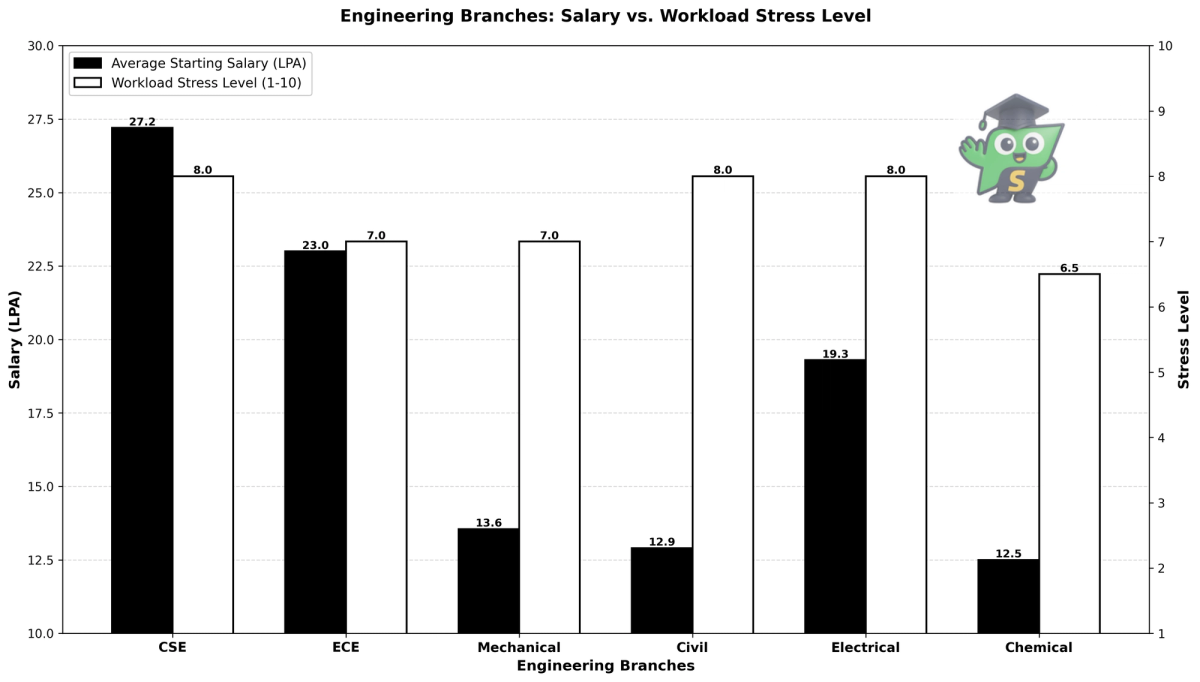
Understanding "Balance" Across Engineering Branches
The idea of “balance” depends on the nature of the job attached to the branch. A computer science job usually offers flexible timing and the option to work remotely, whereas civil engineering roles are tied to construction sites and unpredictable field demands. Electrical engineers may work in shifts, especially in power plants, while mechanical engineers often have field visits and project deadlines that stretch working hours. When you understand how each field functions in the real world, you stop choosing branches blindly and start choosing based on the lifestyle you want after graduation.
How to Manage Both Board Exams and JEE
Computer Science and Engineering (CSE): High Salary, Medium Balance
CSE has become India’s favourite branch for a reason. It offers high salaries, excellent placement rates, and a wide range of career paths—from product companies to startups to freelancing. Many roles offer remote or hybrid work, which gives students and professionals more control over their daily routines. A typical CSE job involves long screen time and constant learning, but the working conditions are generally comfortable.
However, the truth is that not every CSE job gives easy balance. Critical software issues, production bugs, and strict sprint deadlines can create high-pressure periods. The expectation to continuously learn new tools and update your skills can also eat into personal time. But even with that, its flexibility gives it an advantage over many branches. On average, CSE manages a healthier balance than fields tied to physical locations or constant fieldwork, especially because many IT roles allow switching off after work hours if boundaries are maintained.
Mechanical Engineering: Traditional but Field-Heavy
Mechanical engineering is one of the most versatile and respected branches, but it comes with a lifestyle that not everyone is comfortable with. Much of the work happens on factory floors, industrial plants, and manufacturing sites. This means strict timings, project deadlines, and environments that can be physically demanding. Mechanical engineers often work longer hours during project phases, equipment testing, or breakdown maintenance.
Despite the challenges, many students genuinely enjoy the hands-on nature of mechanical engineering. Seeing your design or machine come to life can be deeply satisfying. Factory-based jobs offer stability, but they lack the work-from-home flexibility that many students desire. If you are someone who enjoys tangible engineering and doesn’t mind structured hours, mechanical engineering offers a meaningful experience—just not the most flexible one.
Electrical Engineering: Complex but Stable
Electrical engineering attracts students who enjoy deep concepts and strong scientific foundations. In college, the workload can feel intense because the subjects involve abstract ideas like electromagnetic fields and control systems. After graduation, electrical engineers are needed in sectors where systems must run smoothly—power plants, substations, and industries where downtime isn’t acceptable.
The balance in this branch depends heavily on the job type. Government roles offer excellent stability, clear working hours, and strong long-term balance. Private sector jobs are more dynamic and sometimes involve being on-call for emergencies. Shift systems can help balance things out, but the mental load of working on critical systems is high. Students who enjoy rigorous problem solving and structured environments tend to thrive here.
Civil Engineering: Lower Balance, Higher Fieldwork
Civil engineering is essential for society, but when it comes to balance, it struggles the most. The work is heavily site-dependent. Construction schedules are unpredictable, weather affects work progress, and deadlines are often non-negotiable. Freshers in civil engineering frequently face long working days on-site, often under tough conditions and with lower salaries compared to other branches. Placement rates are also lower, which adds more stress for students.
Civil engineering is meaningful and creative in its own way, but it isn’t ideal for someone who prioritises a stable routine or flexibility. This branch is best for students who are truly passionate about infrastructure and don’t mind the demanding nature of the field. If you want a relaxed or predictable lifestyle, civil engineering will be challenging.
Electronics and Communication Engineering (ECE): Versatile but Niche
Electronics and Communication Engineering sits between software-focused and hardware-focused branches. Students learn both sides, which opens opportunities in embedded systems, IoT devices, automotive electronics, telecommunications, and even software companies. Because of this blend, ECE graduates enjoy better balance than civil or mechanical engineers, but lesser flexibility compared to pure CSE roles.
Work hours can vary a lot depending on the company. Hardware and semiconductor jobs may involve lab time or debugging that stretches late, while software-oriented roles often follow a standard schedule. Students who enjoy a mix of hands-on work and coding usually find ECE engaging and manageable in terms of balance.
Chemical Engineering: Specialized Path with Moderate Balance
Chemical engineering offers a specialised and impactful career, especially in industries like pharmaceuticals, petrochemicals, and food processing. The work is often tied to large-scale production, which means many companies run in continuous shifts. Freshers might have to rotate through different shifts before settling into fixed hours.
College workload is moderate but requires strong fundamentals. The branch offers a reasonably balanced lifestyle if you adapt to shift patterns. Many chemical engineers appreciate the clearer routines of industrial plants compared to the chaos of construction or continuous software learning. Balance here depends on the company rather than the branch itself.
The Global Reality: What Work-Life Balance Actually Looks Like
Even though each branch has its general trends, your real balance comes from your job role and company. A mechanical engineer in a top manufacturing MNC may have better hours than a CSE fresher stuck in a startup with unrealistic deadlines. A civil engineer working with a reputed consulting firm will have more order in life than one with a mid-level contractor. A government electrical engineer may have far more balance than a private-sector software tester.
Understanding this helps you make peace with your branch choice. The branch guides your entry, but your job path shapes your long-term lifestyle.
Mistakes Students Make While Choosing Based on Balance
Many students choose a branch thinking only about salaries and ignore whether the daily work aligns with their personality. Others assume all roles in a branch are the same, when in reality, the variation is huge. Some students underestimate the importance of remote work flexibility and later regret choosing field-heavy branches. Another mistake is confusing college difficulty with career difficulty—some branches feel heavy during college but offer smoother work later, while others flip this entirely. Choosing based on half information leads to decisions that feel wrong as soon as college begins.
If You Feel Stuck: How to Correct Your Branch Path
Even if you choose a branch and later feel unsure, you still have options. Some colleges allow branch change after the first year based on performance and seat availability. Many students also build hybrid skills during college—mechanical engineers learn coding, chemical engineers move into data analytics, civil engineers shift into project management, and electrical engineers move into renewable energy. Your engineering degree gives you a foundation, but your electives, internships, and projects help you shape your direction.
How to decide if a student must attempt a drop year
How Parents Can Support Students During This Decision
Parents often worry about job security, but supporting your child begins with listening. When students talk about balance concerns, they’re not being lazy—they’re thinking about their future mental well-being. Researching branches together, understanding realistic work conditions, and staying open-minded about less “traditional” choices can make decision-making much healthier for the child. Engineering is a long career, and choosing a branch that fits the student’s personality leads to better stability in the long run.
Other Helpful Guides for Your Journey
Here are internal links you may want to explore next:
📌 Signs that a student is suited for CS
📌 Mechanical engineering for the future
📌 How to decide between AI ML and core CS
📌 Common mistakes students make while choosing branches
📌 Which branch fits introverts
📌 Which branch fits creative students
📌 Which engineering branch gives the best work-life balance
📌 Branch myths students should ignore
📌 How to compare branch scope in India vs abroad
How Prof Sam Can Guide Your Branch and College Selection
Choosing an engineering branch is overwhelming, especially when your family, marks, and future all feel interconnected. At Prof Sam, the guidance starts with understanding the student—your interests, your tolerance for pressure, your long-term goals, and your concern about balance. We analyse placement data from colleges you’re considering, compare branches based on real career patterns, explain exam strategies, and help you understand your options through TNEA, JEE Main, and COMEDK.
We also help you compare long-term outcomes—whether mechanical at NIT Trichy is better for you than CSE at a private college, whether a drop year will actually help, and how your interests may evolve over time. Our counselling sessions focus on clarity, not confusion, so that you make a confident choice instead of an anxious one.
Complete Guide to Engineering Entrance Exams for Tamil Nadu Students
TNEA vs COMEDK
What rank is needed for NIT Trichy
Strengthen your Class 12 fundamentals on ScoreLab
Free video lessons, revision notes, formula sheets, and past-paper MCQs for CBSE Class 12.
Need Personalized Guidance?
Book a consultation with Prof Sam and get expert advice tailored to your child's unique needs.
Book Your Consultation