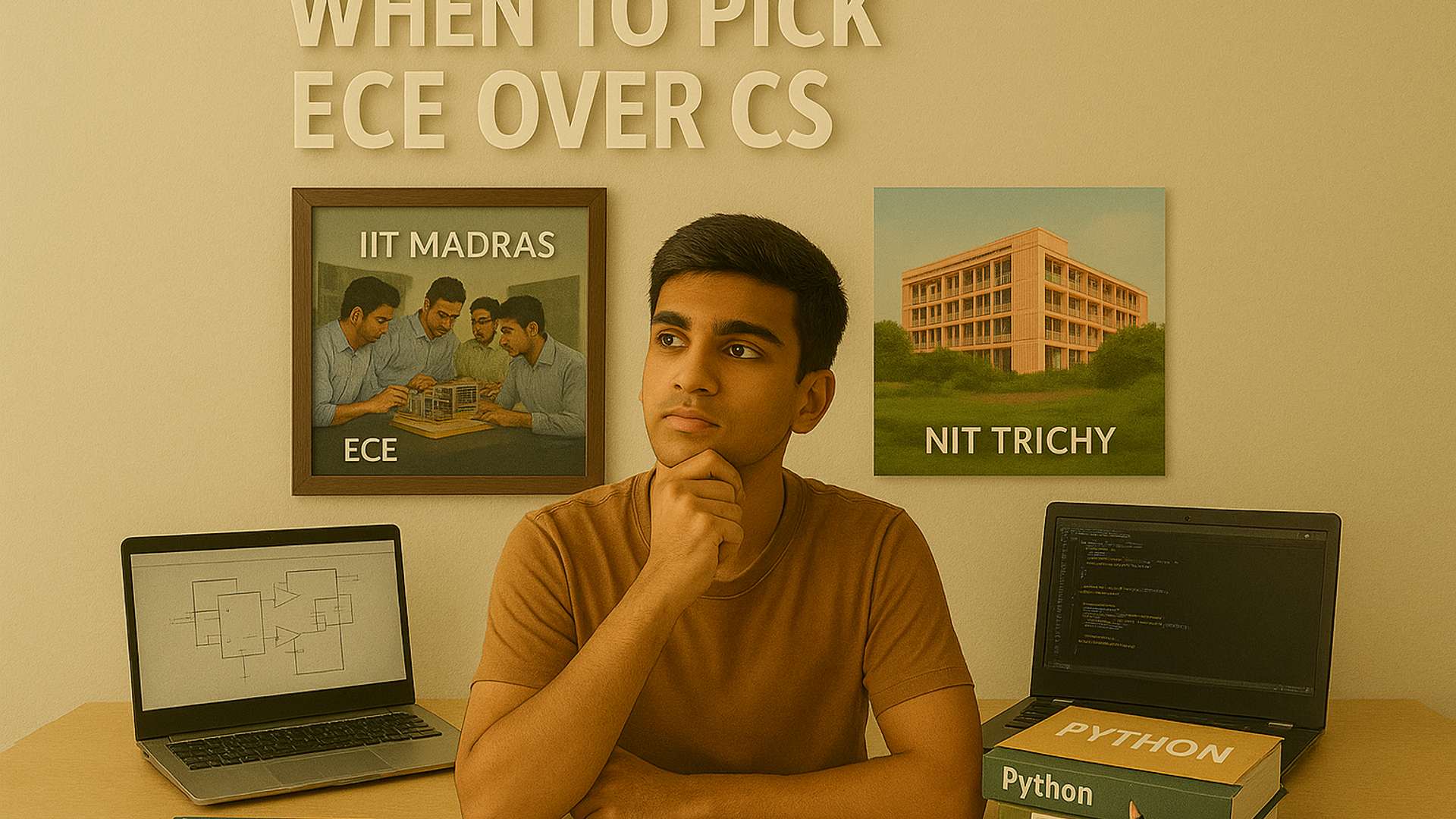
When to pick ECE over CS
Should you choose ECE over CS? Discover 6 key signs that ECE might be the better fit for Tamil Nadu engineering students, plus realistic insights on careers and placements.
If you're a Class 11 or 12 student in Tamil Nadu right now…
Choosing between Computer Science and Electronics & Communication Engineering can feel heavier than it should. You hear it everywhere: “Go CS — placements are best,” or “ECE is just for people who like hardware.” Those short lines pile up into big pressure — from coaching centres, from friends, and usually from parents who want the safest option. The problem is that many students who would genuinely enjoy ECE bend toward CS because it looks safer on paper, and then they spend four years unhappy or confused. This isn’t about picking the branch that looks best on Instagram — it’s about matching the subject to what actually makes you curious and motivated, because that’s what will make college and career satisfying. Below I’ll explain what ECE really is, what kinds of students tend to thrive in it, and how to tell if it’s a better fit for you than CS — in plain language, not scenarios or lists of buzzwords.
The ECE Reality That Nobody Talks About
A lot of the myths around ECE come from outdated images: students with soldering irons or technicians fixing appliances. That’s not the full picture. ECE is about how the physical side of technology works — how signals travel, how sensors detect the world, how chips are designed, and how hardware and software work together. Today’s ECE students write code for microcontrollers, design embedded systems, work on wireless communication, and build devices that connect to the internet. In Tamil Nadu colleges you’ll study both theory and labs: circuit theory, signal processing, microprocessors, communication systems, and embedded programming. The first year overlaps a lot with CS — basics in math, physics, and programming — and then things branch out. ECE sits at the intersection of physics and computing, and that combination is what drives real-world devices like phones, medical equipment, IoT sensors, and EV power systems.
Sign 1: You Genuinely Enjoy Understanding How Physical Systems Work
If you pick up a gadget and wonder what the little components do, or if you enjoyed the electricity-and-magnetism chapters in school because they explained how things actually function, ECE may click for you. You don’t have to be an electronics prodigy — you just need curiosity about how the unseen parts of technology behave. Where some people love refining an app’s UI, others get energy from figuring out why a circuit behaves a certain way. That urge to look under the hood and connect math or physics to real behavior is a strong sign that ECE could suit you.
Sign 2: You're Strong in Mathematics, Particularly Applied Mathematics
Math in ECE is not optional background noise — it’s the language you use to model and design systems. Signal processing, circuit analysis, communication theory and electromagnetics all use tools like transforms, differential equations and probability. If you enjoy math that explains real systems — seeing equations translate into measurable results — you’ll find ECE rewarding. If you dread continuous math and just want to write user-facing code, CS might be easier to enjoy. The distinction isn’t “good at math” versus “bad at math” — it’s more about whether math feels like a useful tool to you rather than a chore.
Sign 3: You're Interested in How Systems Work at a Deeper Level
Some students are content to build apps; others want to know why the hardware underneath behaves the way it does. ECE attracts the latter: people who ask why signals weaken over distance, or how an antenna design affects range, or how an embedded controller manages a motor. That deeper curiosity and desire to understand constraints, trade-offs, and physical limits is central to ECE thinking. If you’re driven by foundational “why” questions, you’ll likely find the subject satisfying rather than frustrating.
Sign 4: You're Comfortable Working with Both Theory and Practical Experiments
ECE blends classroom derivations with practical lab work. You’ll often move between pencil-and-paper analysis and soldering or breadboarding to test hypotheses. This tactile, measurement-based troubleshooting is a core part of the learning loop. If you like applying theory and seeing a waveform on an oscilloscope or debugging why a circuit’s output is off, that hands-on element will keep you motivated. If you prefer everything to stay inside a computer and never touch hardware, CS will probably fit your temperament better.
Sign 5: You're Interested in Real-World Applications and Sensing the Physical World
If autonomous vehicles, IoT sensors, robotics, telecom networks, medical devices, or power electronics make you curious, ECE aligns directly with those interests. These domains need engineers who understand both the sensing/communication side and the software that runs on it. ECE gives you the tools to build systems that interact with the physical world — which is different, but equally impactful, compared to building purely software services.
Sign 6: You Want a Broader Technical Foundation Without Being Locked into Software
An ECE background gives you options. You can specialize in VLSI and chip design, embedded systems, signal processing, telecommunications, IoT, or move toward robotics and control systems. You can also learn software later; many ECE grads do full-stack or machine learning work after gaining some software experience. If you’re not ready to commit to strictly software-based work for your entire career, ECE keeps more doors open early on.
Common mistakes students make when dismissing ECE
A few common traps lead people away from ECE unfairly. First, assuming it’s “old fashioned” — it’s not; modern devices, 5G, EVs, sensors, and semiconductors are all ECE-driven. Second, thinking ECE is only about fixing broken electronics — it’s about designing complex systems. Third, assuming ECE placements are weak — from top colleges, ECE graduates get recruited by global semiconductor, telecom, and embedded systems firms. Fourth, letting prestige narratives push a student into CS even when they’re actually excited by hardware and signals. Those mismatches are the real cause of unhappy college years.
The reality of ECE placements and career in Tamil Nadu
From strong Tamil Nadu institutions, ECE placements are healthy. Top recruiters include semiconductor firms, telecom companies, automotive companies working on EVs and ADAS, and industries building embedded solutions. Entry salaries may be slightly lower on average than CS at times, but specialization (chip design, RF engineering, embedded systems) leads to very competitive pay and career growth. Also, the industry mix is broad — you can work in consumer electronics, defense, industrial automation, healthcare devices, telecom infrastructure, and more.
How parents can support their child’s ECE decision
If you’re a parent, your role is to listen, explore, and help your child test their interest rather than pushing them toward the “safest” brand name. Encourage them to try a small embedded project or an introductory electronics course before deciding. Recognize that ECE requires steady math and lab work and that those skills pay off in fields that are important to national infrastructure and manufacturing. Avoid equating CS automatically with success; instead ask what excites your child, and support their curiosity with realistic information about courses and careers.
Guidance: when to seek professional help
If you truly can’t decide, talking to a counselor who understands local college strengths and industry trends is useful. A counselor can help assess your aptitude and suggest practical early experiments — small projects, online courses, or internship paths — so you make a choice based on experience rather than hearsay. This is especially helpful when comparing JEE, TNEA, or COMEDK pathways and considering which colleges have strong ECE programs.
Making Your Decision: A Practical Framework
Think about what you enjoy day-to-day. Do you get excited by troubleshooting physical systems, by lab experiments, or by understanding sensors and signals? Or do you feel more drawn to building software and algorithms? Ask which types of problems you want to solve five years from now. If physics, hardware, and systems thinking energize you, ECE is likely a better match. If you prefer purely digital problems and product-side software development, CS is probably more comfortable.
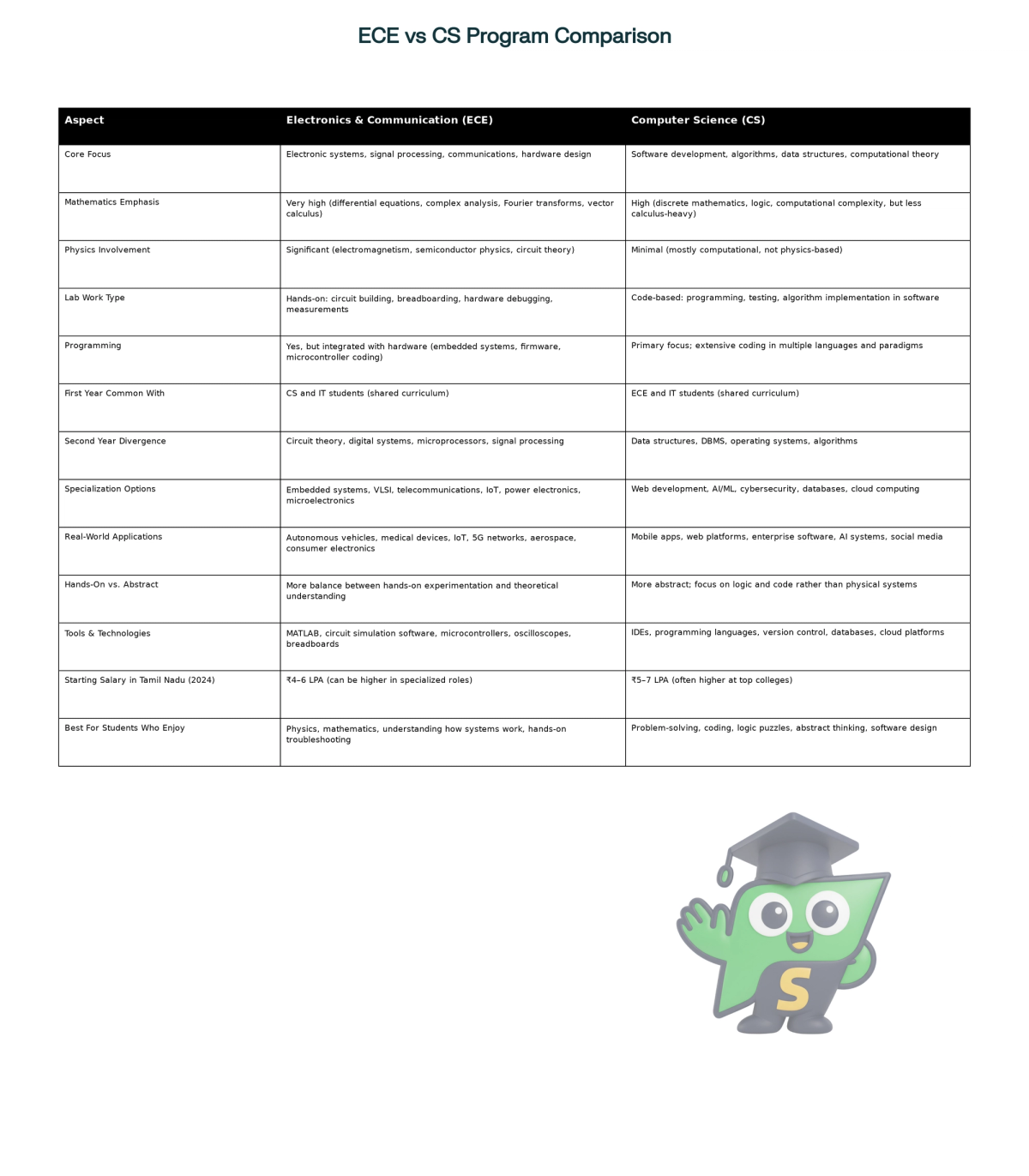
ECE vs. CS—Key Differences and Suitability Factors
The Bigger Picture: Your Choice, Your Journey
Neither branch is inherently better. CS and ECE are different pathways that suit different temperaments. ECE is not a consolation prize — for many students it is the truer fit, offering work that is deep, tangible, and widely respected. What matters most is choosing for the right reasons: curiosity, interest, strengths, and the kinds of problems you enjoy solving.
Other Helpful Guides for Your Journey
Here are internal links you may want to explore next:
📌 Signs that a student is suited for CS
📌 Mechanical engineering for the future
📌 How to decide between AI ML and core CS
📌 Common mistakes students make while choosing branches
📌 Which branch fits introverts
📌 Which branch fits creative students
📌 Which engineering branch gives the best work-life balance
📌 Branch myths students should ignore
📌 How to compare branch scope in India vs abroad
Conclusion: Trusting Your Genuine Interests
This decision matters, but it doesn’t lock you for life. Pick what aligns with your curiosity now, try small projects to test your instincts, and be willing to adjust as you learn. If you genuinely enjoy the physics, math, and hands-on side of technology, ECE is a strong, modern, and rewarding choice — not second-best, but different. Make the decision based on what excites you, and then commit to learning and growing in that direction.
When Your Aptitude and Passion Actually Conflict
There's one scenario we should address directly: sometimes a student's aptitude and their passion don't align perfectly.
For example, imagine a student who is naturally very strong in mathematics and physics, who has the potential to excel in ECE, but who is genuinely more excited about building software applications and mobile apps. Or conversely, a student who loves the idea of embedded systems but struggled in math and physics in Class 10.
Here's the honest truth: aptitude and passion are both important, but if you must choose between them, choose passion with realistic eyes. A student who is passionate about something will put in the effort to develop the necessary aptitude. They'll struggle more, perhaps, than someone with natural aptitude, but they'll persevere because they care about the outcome.
Conversely, a student with great aptitude but no genuine passion will do fine initially, but over time, the lack of genuine interest will catch up. They might get good marks, but they won't be motivated to go beyond the minimum, and their career will be less fulfilling.
So if you're genuinely passionate about ECE but your math is currently weaker, that's okay. You can improve your math fundamentals during college. Many successful ECE engineers weren't math prodigies initially. But you need to be willing to put in the work.
Similarly, if you're strong in math but more passionate about software, choose CS. Your math foundation will actually serve you well in CS too, especially if you go into algorithm-heavy areas or AI/ML.
The key is alignment between your interests and your willingness to do the work. If that's there, even if aptitude isn't perfect initially, you can succeed.
The Perspective of Time
Here's something that becomes clear only after you've been through the whole journey: the branch you choose in Class 12 matters less than you think right now, and more than you think later.
It matters less because if you make a suboptimal choice, you can usually course-correct. You can do a specialized master's degree. You can transition into related fields. You can learn new skills on the job. The engineering and tech worlds are more flexible than they appear from the vantage point of Class 12.
But it matters more in the sense that if you choose poorly, those four years of college will be hard. You'll struggle, feel demotivated, and miss out on the learning and friendships that could have been. So even though the long-term stakes are lower than they feel right now, the quality of your college experience depends significantly on this choice.
Make an informed choice. Choose based on genuine understanding of the fields and yourself. And then trust that choice.
Strengthen your Class 12 fundamentals on ScoreLab
Free video lessons, revision notes, formula sheets, and past-paper MCQs for CBSE Class 12.
Need Personalized Guidance?
Book a consultation with Prof Sam and get expert advice tailored to your child's unique needs.
Book Your Consultation