Signs That a Student Is Suited for Computer Science
Is Computer Science right for you? Discover 6 key signs that a Tamil Nadu engineering student is suited for CS, plus realistic insights on the journey ahead and how parents can help
If you're a Class 11 or 12 student in Tamil Nadu, or if you're a parent watching your child navigate the engineering pathway, you've probably felt that moment of uncertainty: Is Computer Science the right choice for my child? This question shows up in almost every counseling session, in school corridors, and in many Tamil Nadu homes. And it deserves a thoughtful explanation—not a rushed checklist or a simple yes/no answer.
The truth is that Computer Science has become the most sought-after engineering branch in Tamil Nadu. High cutoffs, strong placements, and the popularity of IT jobs have made CS feel like the “default choice” for many families. But high demand doesn’t automatically mean the branch suits every student. At the same time, not being naturally gifted in coding or math right now doesn’t mean a student cannot excel in CS. What matters more is mindset, interest, and willingness to learn.
This blog walks you through the real, practical signs that show whether a student is genuinely suited for CS—not stereotypes, not myths, and not outdated assumptions. Good decisions come from clarity, and clarity comes from understanding what CS truly demands and what kinds of students thrive in it.
Understanding What Computer Science Really Means
Before identifying the signs, it’s important to understand what CS actually covers. Many students think CS is “just programming,” but the branch is far broader. It deals with how computers work at a fundamental level—how data is stored and processed, how algorithms solve problems, how systems interact, and how software is designed, tested, and maintained.
Students typically learn programming languages like Python, C, Java, and C++, along with data structures, database systems, computer networks, and operating systems. Later years may include AI, machine learning, cybersecurity, or cloud computing. There is also theoretical work—discrete math, theory of computation, and compiler design—which form the backbone for deeper understanding.
In Tamil Nadu engineering colleges, the first year is common for all branches. From second year onward, CS becomes more specialized with labs, projects, and assignments. This is where students realize that CS isn’t just typing code but understanding concepts, debugging problems, and thinking logically. Many students enter CS expecting it to be simple or only practical, and get overwhelmed by theory. Others think only toppers can survive it. Both mindsets come from misunderstanding the nature of CS. It is an engineering discipline that combines theory, logic, problem-solving, and creativity.
Sign 1: You Genuinely Enjoy Solving Problems, Especially Logical Ones
The strongest indicator that a student is suited for CS is a natural interest in solving problems. Whether it’s math puzzles, logic games, or debugging simple code, CS students usually enjoy figuring things out. You don’t need to be a math topper; you need curiosity. If you look at a problem and feel motivated to break it into smaller parts, explore different approaches, or ask “why does this work?”—that’s CS thinking.
Tamil Nadu students often memorize formulas for exams, but real CS rewards deeper understanding. Those who enjoy the thinking process more than just getting the right answer tend to thrive.
Sign 2: You're Comfortable with Abstraction and Logical Thinking
Abstraction means understanding ideas at different levels without needing every detail. When you use WhatsApp, you don’t know exactly how the servers work—but you understand the system conceptually. That is abstraction.
In CS, abstraction and logic are everywhere. Designing systems, writing code, tracing algorithms—all require step-by-step reasoning and visualization. If you naturally think in cause-and-effect, or can mentally follow instructions in sequence, CS will feel intuitive.
Students from Tamil-medium backgrounds often fear English terminology, but logical thinking itself is language-neutral. Once concepts make sense, the vocabulary becomes easy.
Sign 3: You're Willing to Embrace Continuous Learning and Adaptation
CS changes constantly—new frameworks, new languages, new tools, new demands. What you learn in first year may evolve by the time you graduate. Students who enjoy learning new things and don’t panic when faced with unfamiliar concepts tend to excel.
Debugging, experimenting, and trying different approaches are essential. Those who expect to understand everything on the first try often struggle. Those who say “I’ll learn it slowly” thrive. CS rewards curiosity and persistence, not perfection.
Sign 4: You Find the Intersection of Creativity and Logic Appealing
Many people don’t realize CS involves creativity—designing apps, visualizing data, writing elegant algorithms, building user-friendly interfaces. If you enjoy both structured thinking and creative ideas, you’ll find CS exciting.
Careers like UI/UX, game development, AI visualization, and web development blend creativity with logic beautifully. Students who like imagining possibilities and then building them often enjoy CS the most.
Sign 5: You Enjoy Building Things and Seeing Tangible Results
CS is one of the few engineering branches where you see instant results. When you write a program or build a website, you can test it immediately. That feedback is satisfying and motivates students who like making things.
Students who enjoy creating—even small projects—usually stay more engaged throughout their degree. It’s not about being tech-savvy; it’s about liking the creation process.
Sign 6: You're Willing to Invest Time in Learning That Might Not Have Immediate Payoff
Some CS subjects feel abstract—discrete math, automata theory, formal languages. Students sometimes wonder how these relate to real programming. But these topics build foundational thinking required for long-term success.
Students who are patient with theory and can appreciate its value later usually develop deeper skills. Jumping straight into flashy technologies without understanding the basics can cause problems later.
What CS Is Not a Match For
CS may not be ideal if a student prefers working with physical objects instead of abstract concepts. Those who dislike ambiguity or trial-and-error may also struggle, as CS requires experimentation. Students needing highly structured environments may prefer branches like mechanical or civil engineering. And students who resist self-learning may find CS hard, because much of the field requires independent exploration.
Common Mistakes Students Make When Choosing CS
Many Tamil Nadu students choose CS only for placements or salary, which is risky because lack of genuine interest often leads to burnout. Others assume they must be natural coders or confuse gaming skills with programming aptitude. Another common mistake is expecting passion to appear magically—real passion develops only after exploration and experience. Some ignore the continuous learning aspect and expect CS to be static, which it isn’t.
How Parents Can Support Their Child's CS Decision
Parents can help by asking thoughtful questions, encouraging small experiments with coding, managing expectations, and supporting the child emotionally. Engineering is difficult—children need reassurance more than pressure. Parents should focus on growth rather than marks and help children find good guidance when needed.
The Role of Guidance: When and How to Seek Help
With multiple pathways like JEE, TNEA, and COMEDK, professional guidance can help students find the right direction. Good counselors help students identify strengths, clarify doubts, and choose the right college or specialization. Guidance reduces confusion and helps both parents and students feel confident.
Making Your Decision: A Practical Framework
If a student resonates with at least four of the six signs strongly, CS is likely a good fit. If they resonate with more, CS is probably an excellent choice. But the final decision should consider personal interest, willingness to learn continuously, realistic expectations, and long-term goals.
Table Instruction 1: CS vs. Other Engineering Branches—Key Differences and Suitability Indicators
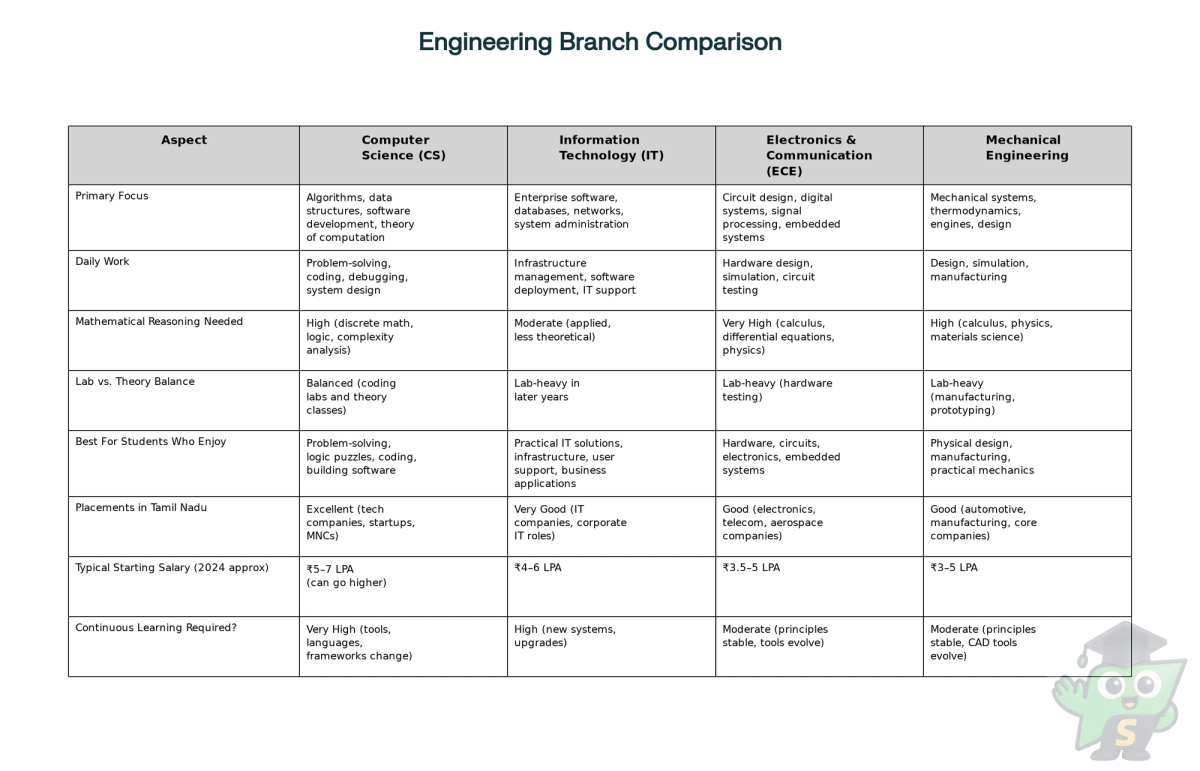
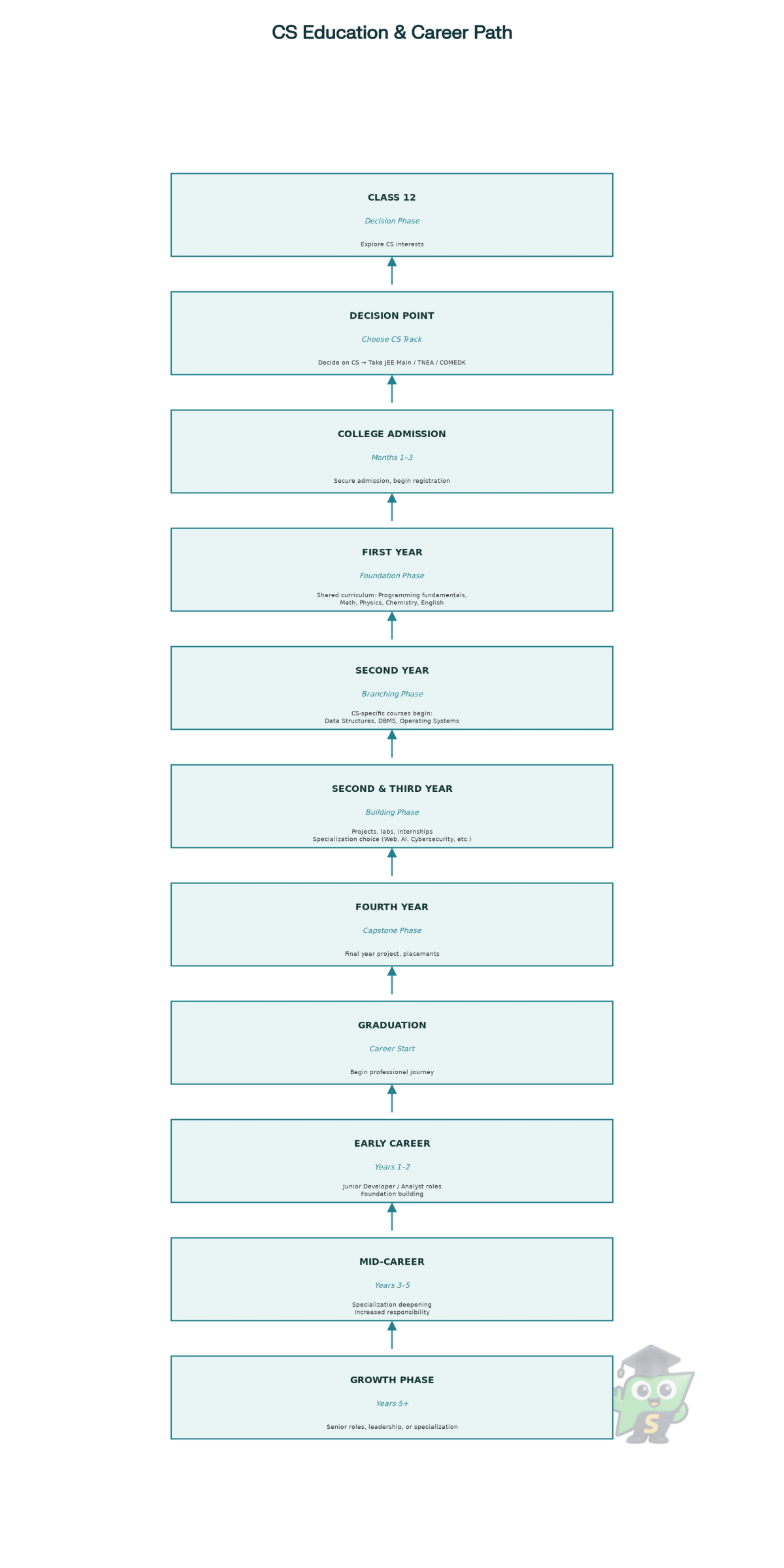
Chart Instruction 1: The CS Learning Journey—From Class 12 to Career
Realism Check: What You Should Know Before Committing to CS
CS is competitive, but that shouldn’t scare you. Not every CS graduate becomes a software engineer, and that flexibility is a strength. Getting into CS doesn’t guarantee placements; skills, projects, and mindset matter more. The job market evolves quickly, and marks help but don’t define success.
Other Helpful Guides for Your Journey
Here are internal links you may want to explore next:
📌 Signs that a student is suited for CS
📌 Mechanical engineering for the future
📌 How to decide between AI ML and core CS
📌 Common mistakes students make while choosing branches
📌 Which branch fits introverts
📌 Which branch fits creative students
📌 Which engineering branch gives the best work-life balance
📌 Branch myths students should ignore
📌 How to compare branch scope in India vs abroad
Conclusion: Trusting Your Choice
Choosing an engineering branch is one of the more significant decisions you'll make in your teenage years. It affects your next four years, your early career, and indirectly, many aspects of your life. So it makes sense that this choice feels heavy.
But here's something important to remember: this decision is informed and reversible to some extent. You're not committing to CS for your entire life based on your current knowledge. You're saying, "Based on what I understand about myself and CS, this seems like a good fit for the next phase." If later you discover it's not the right fit, there are options—specializations, career transitions, further studies—to explore.
The signs we've discussed aren't predictors of success. They're indicators of alignment. A student who resonates with most of these signs is likely to find CS engaging and fulfilling. But even a student who's unsure about some signs can still succeed if they're willing to learn and genuinely curious.
So, take your time. Ask yourself the hard questions. Talk to people actually studying or working in CS. Try some basic coding if you haven't. Seek How to Choose Coaching for JEE in Tamil Nadu or counseling if you're still uncertain. Make your decision not based on what others expect, but based on what genuinely seems right for you.
Strengthen your Class 12 fundamentals on ScoreLab
Free video lessons, revision notes, formula sheets, and past-paper MCQs for CBSE Class 12.
Need Personalized Guidance?
Book a consultation with Prof Sam and get expert advice tailored to your child's unique needs.
Book Your Consultation