
How early planning affects college admissions
Learn how early planning transforms engineering admissions for Tamil Nadu Class 11 and 12 students, with practical guidance for students and parents.
Early planning does not mean studying sixteen hours a day. It simply means understanding the full picture early and moving step by step, instead of running in panic at the end. It changes everything.
Why Tamil Nadu Students Need Early Planning
Tamil Nadu focuses heavily on TNEA and board marks. But engineering admissions today offer multiple paths: TNEA, JEE Main, COMEDK, BITSAT, VITEEE, SRMJEEE. Each has different patterns, dates, and competition levels. Understanding this only in Class 12 leaves you lost.
TNEA converts your board marks in Math, Physics, and Chemistry to a score out of 200. Top colleges like Anna University CEG need very high cutoffs. A five-mark drop can move you from a top to a mid-tier college.
JEE Main is concept and problem-solving based. A good percentile opens NITs and IIITs. NIT Trichy is huge for Tamil Nadu students, but its cutoffs are tight. You cannot manage JEE in six months. It needs early preparation.
The more you plan ahead, the more doors stay open across India. The later you start, the more doors quietly close.
How Early Planning Changes Your Two Years
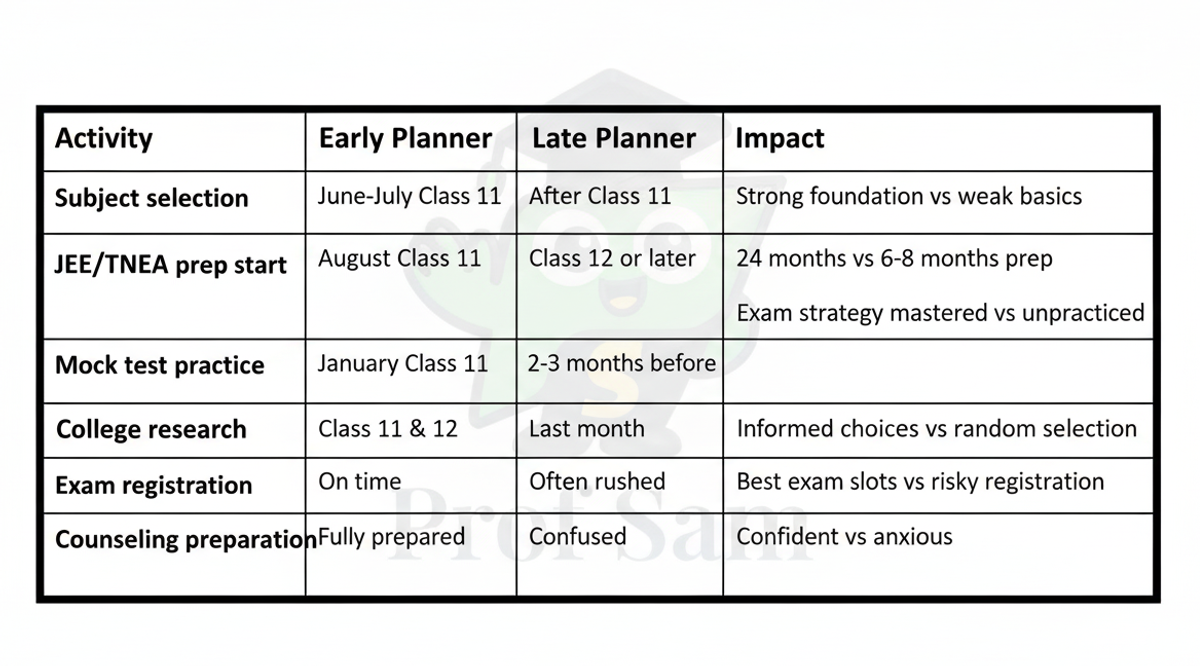
Arjun decides in Class 11 that he wants engineering. He learns about TNEA, JEE Main, COMEDK, and BITSAT. He understands that Class 11 concepts form JEE's backbone. From June of Class 11, he spends three to four hours daily building strong basics from NCERT. He treats school and entrance prep as one combined journey.
By August, he is doing JEE-level questions. By January of Class 11, he writes his first full mock. He scores badly at first but learns exam patterns. Throughout Class 11 and 12, he slowly improves. He also researches colleges on weekends. By Class 12, he has a priority list ready.
Meera is bright, but everyone says, "First focus on boards, then we will see." She studies hard for school tests but never sees JEE questions. In January of Class 12, her teacher casually says, "You should also try JEE Main." She panics and gives up. During TNEA counseling, she realizes her marks are not enough for her dream college.
The difference is not intelligence. It is timing.
Early vs Late Planning Timeline
Balancing Boards and JEE Without Burning Out
Many Tamil Nadu students fear: "If I start JEE, will my board marks drop?" The truth is, boards and JEE support each other if you plan correctly.
Boards test textbook learning. JEE tests application of that knowledge. Deep JEE prep strengthens textbook understanding. If you manage time smartly, JEE prep improves board performance.
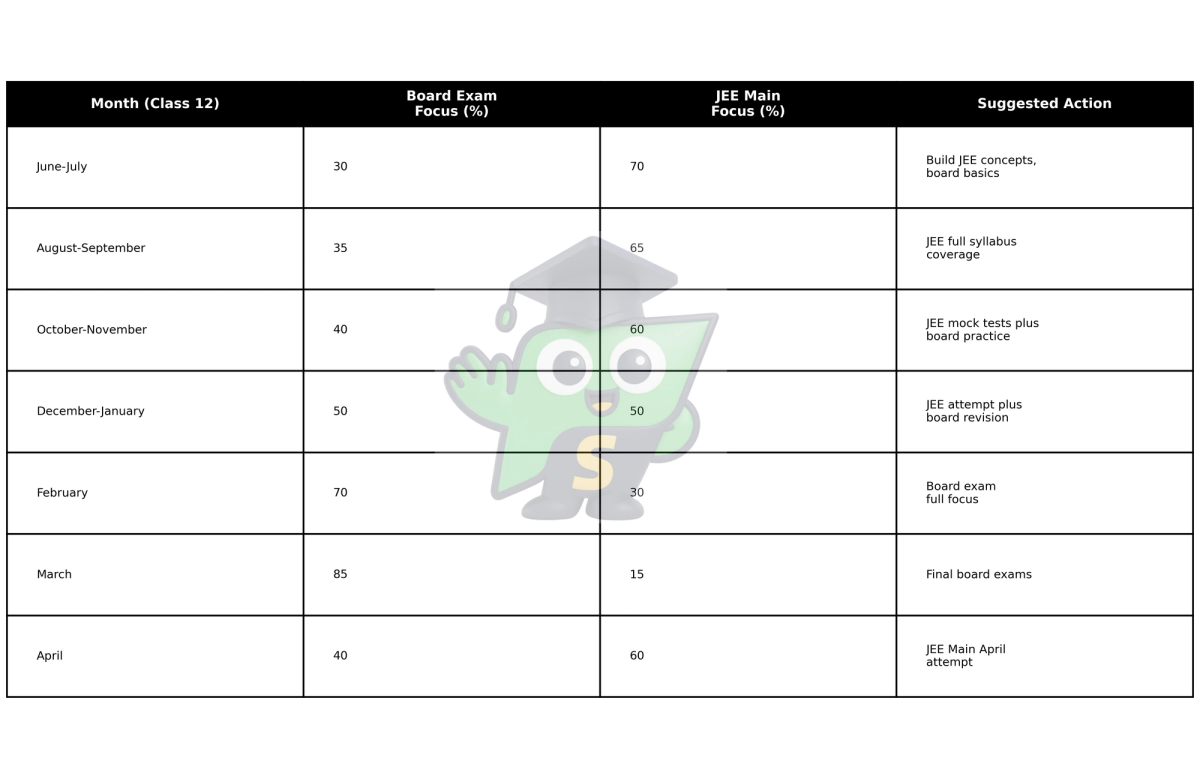
From June to November of Class 12, give slightly more time to JEE concepts. School tests are not ignored, but concepts come first. From December to January, make it 50–50. JEE Main Session 1 and pre-board exams both need attention. From February to March, boards take priority. Heavy revision, previous papers, important derivations. JEE practice continues lightly. In April, after boards, focus strongly on JEE Main Session 2. This rhythm keeps both paths open.
Time Distribution Between Boards and JEE (Class 12)
Common Mistakes Students Make
Memorising instead of understanding. Tamil Nadu exam culture trains you to memorise "important 5 marks" and "expected questions." This fails in JEE. When a question looks slightly different, you are stuck. The fix: slow down and ask "why" whenever you learn a formula. Spend time on basics. Your speed increases naturally later.
Postponing mock tests. Students say, "I will write mocks after finishing the syllabus." The syllabus never feels finished. You delay repeatedly. Suddenly it is one month before JEE, and the first mock hits hard. Start small chapter-wise tests in Class 11, then full mocks in Class 11 end and Class 12. Early low scores are not shame; they are training.
Ignoring college research until counseling. Many think every branch and college are the same. They are not. Computer Science, ECE, Mechanical, and Civil lead to very different work. Colleges differ greatly in placements and faculty. Start reading, talking to seniors early. Use resources like Complete Guide to Engineering Entrance Exams for Tamil Nadu Students, Should Tamil Nadu Students Write JEE? , and TNEA vs COMEDK.
No backup plans. Many only think of "top NIT or Anna University CEG." If that does not work, they feel everything is over. Always have dream, target, and safe options. Backup plans mean you are practical.
How Early Planning Expands Your College Options
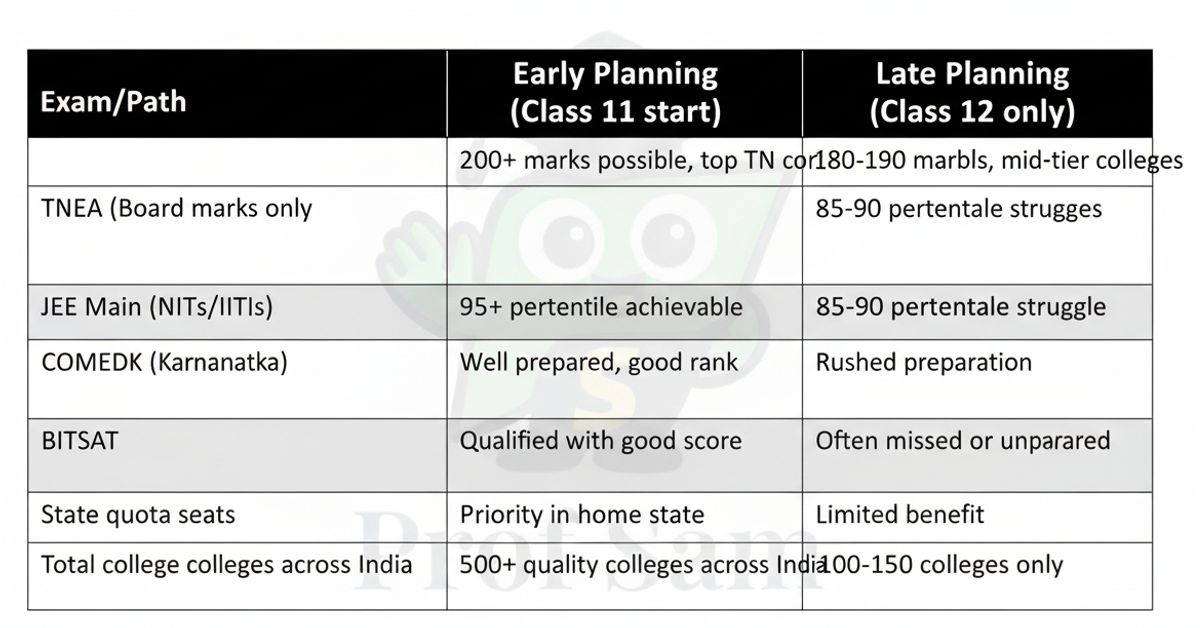
Planning from Class 11 multiplies your choices. You realistically aim for strong TNEA cutoffs, good JEE percentiles, and decent performance in COMEDK and BITSAT. This creates choices across Tamil Nadu, NITs, and good private universities nationwide.
When you start late, options narrow. Your TNEA cutoff restricts you to mid-tier colleges. JEE percentile may not reach NITs. You might skip exams like COMEDK completely because you missed registration.
College Options – Early vs Late Planning
How Parents Can Support This Process
Understand the exam landscape. Read about TNEA, JEE Main, NITs, and private colleges. This prevents unrealistic expectations.
Focus on environment. Give your child a quiet study space, regular meals, and enough sleep. A rested child performs better than an exhausted one.
Support backup plans. It is okay if your child's path is NIT, Anna University, a private college, or even a thoughtful drop year. Decide calmly. Resources like How to decide if a student must attempt a drop year and How to Choose Coaching for JEE in Tamil Nadu can help. Consider professional career counseling for structured guidance on student decision making after twelve and branch confusion help.
Quick Reference
📌 How parents can guide without pressure
📌 When students should take a gap year
📌 How to handle confusion between multiple branches
📌 How to talk to teens about career choices
📌 Why many students regret their college choice
📌 How to know if coaching is actually needed
📌 When to seek professional counselling
📌 How early planning affects college admissions
📌 How parents can avoid common mistakes
📌 How to plan finances for four years of engineering
How Prof Sam Helps You Plan Early
Prof Sam helps you and your parents understand all options: TNEA, JEE Main, COMEDK, NITs, IIITs, and top private colleges. You get clarity on which exams to write, how to balance boards and JEE, and which branches suit your interests. Explore How to Manage Both Board Exams and JEE | Prof Sam's Consulting.
Prof Sam also supports difficult conversations: whether to consider a drop year, which coaching works best, and how to handle stress.
Your marks matter, but they do not define your worth. You are more than a rank or cutoff. Early planning is not about pressure. It is about peace.
If you are in Class 11 or early Class 12, start planning now. You still have time to change your story.
Need Personalized Guidance?
Book a consultation with Prof Sam and get expert advice tailored to your child's unique needs.
Book Your Consultation