
What students must do right after receiving class ten or twelve board results
Complete guide for TN students after Class 10/12 results: TNEA cutoffs, JEE options, stream selection, revaluation, low marks solutions & career counseling.
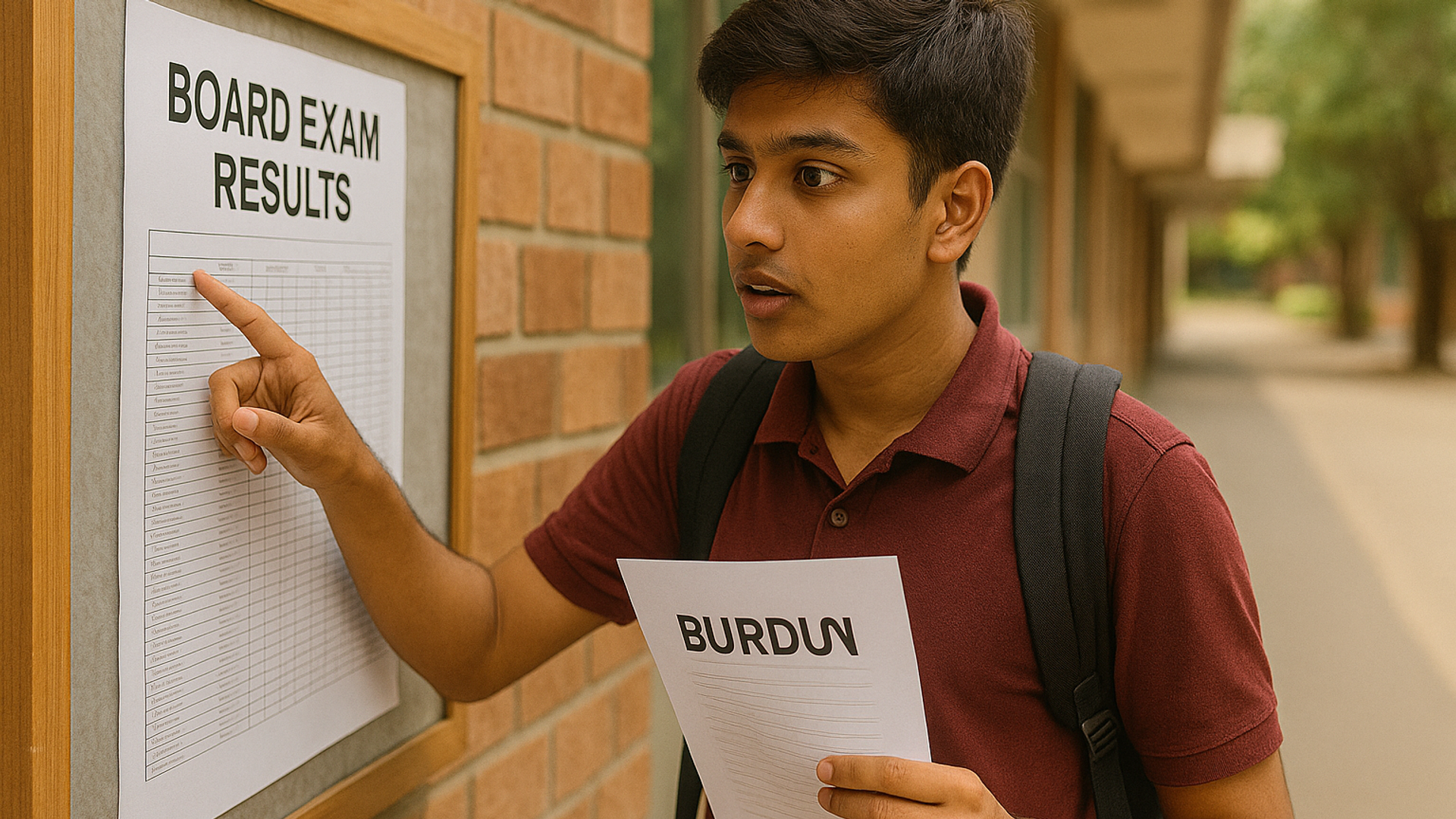
You refresh the page again, hands slightly shaking. The Tamil Nadu Board results appear, and suddenly the numbers feel like they decide everything. Your mother stands behind you, your phone keeps buzzing, and you feel relief and worry at the same time.
This moment is big — but what you do in the next 15–30 days matters even more. The results are fixed, but your response now can shape your college, branch, and career. High score or not, there’s a clear roadmap to follow.
This is the time for calm, informed decisions. Let’s focus on what comes next.
The First 48 Hours: Verify, Breathe, and Assess
When you first see your results, it’s normal to feel overwhelmed — some compare marks immediately, others avoid the marksheet. Both are natural, but not helpful. Your first step is simple: download the official marksheet PDF from the Tamil Nadu DGE portal. Don’t rely on screenshots. Check your name, DOB, subject marks, totals, and percentage carefully. Mistakes do happen and can affect your eligibility, so if you find an error, note it and inform your school and board office quickly.
Once this is done, pause. Allow yourself to feel whatever comes — disappointment, relief, worry — without letting emotions push you into rushed decisions. Take a few hours to settle before deciding what to do next.
Understanding Revaluation and Retotalling: Is It Worth It?
Students often rush to apply for retotalling or revaluation. Retotalling simply re-adds your marks and checks for unmarked answers. It costs ₹205 per subject (₹305 for two-paper subjects) and takes 10–15 days. Revaluation involves a full recheck by another examiner, costing ₹505 per subject, and requires you to first download the scanned answer sheet for ₹275.
Honestly, revaluation rarely increases marks unless you’re close to a crucial cutoff. Retotalling is safer and cheaper if you feel your marks don’t reflect your performance. But remember, counseling deadlines won’t wait — plan your next steps assuming your current marks.
For Class 10 Students: Choosing Your Stream Without Regret
Your stream choice shapes the next two years and future options. Many students in Tamil Nadu choose Science because of marks or peer pressure, but Class 11–12 Science is far harder than Class 10. High marks in Science don’t guarantee you’ll enjoy advanced Physics, Chemistry, and Math.
Choose based on genuine interest, not marks or friends’ choices. Commerce is ideal for business, accounting, finance, and management careers. Arts/Humanities suits those interested in society, psychology, literature, design, media, law, and civil services. Every stream has strong career paths.
If confused, speak to a career counselor. Aptitude tests and guidance can prevent choosing the wrong stream. Class 11 marks don’t count for admissions, but the concepts form the foundation, so choose a stream you can handle with interest.
For Class 12 Students: Decoding TNEA Eligibility and Cutoffs
TNEA admissions depend entirely on your Class 12 marks. The cutoff is calculated as:
Maths (×1) + Physics (÷2) + Chemistry (÷2) = 200 marks.
This cutoff determines your rank and college options.
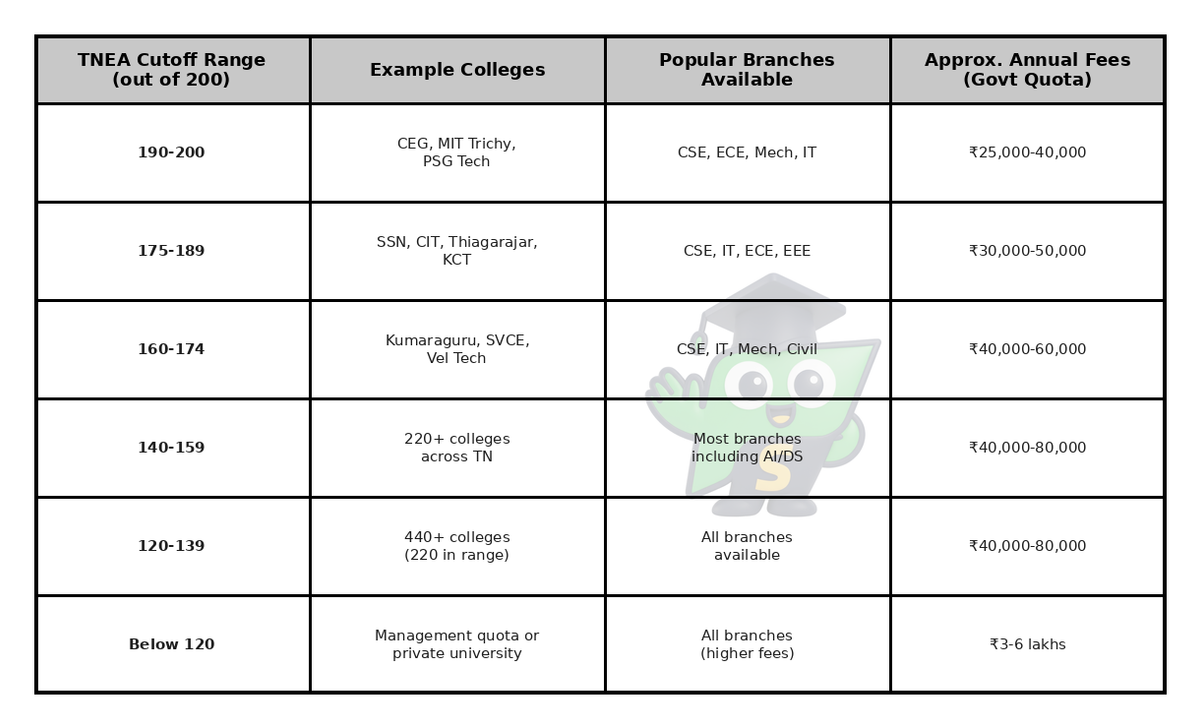
Eligibility requires 45% in PCM for General category and 40% for BC/SC/ST. Top colleges like CEG, MIT, NIT Trichy, PSG, and CIT usually need cutoffs above 190 for CSE/ECE. Cutoffs between 175–189 give access to strong colleges like SSN and Thiagarajar. Even with 120–159, hundreds of colleges remain available. Below 120, management quota is an option, though fees are higher.
TNEA Cutoff Marks vs College and Branch Options
Understanding JEE Main for Tamil Nadu Students
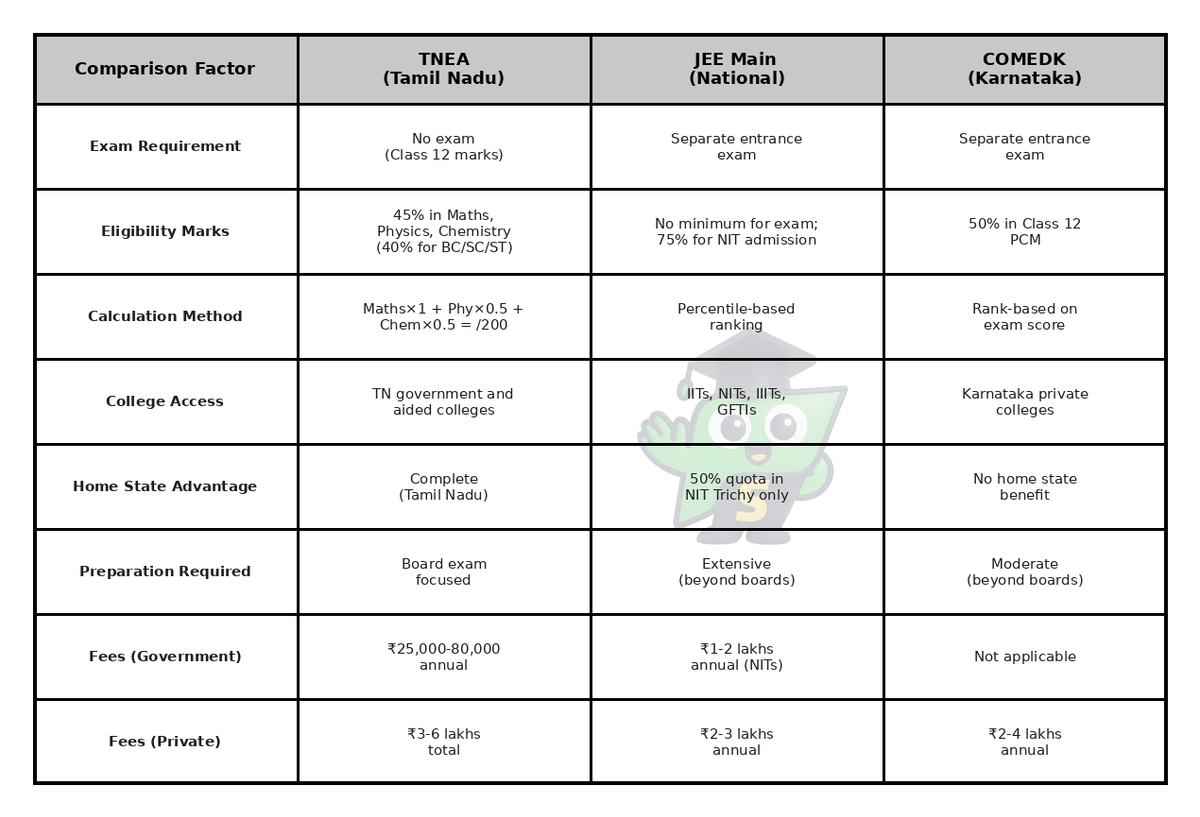
Any PCM student can write JEE Main — no minimum percentage required. But to join IITs/NITs/IIITs, you need 75% (General/OBC) or 65% (SC/ST) in Class 12 or be in the top 20 percentile.
NIT Trichy offers a 50% home-state quota, giving Tamil Nadu students a slight advantage. IITs have no home-state preference. Percentiles above 95 open strong NIT options; above 98 opens top NITs and some IIT opportunities.
JEE is competitive and far tougher than board exams, so without focused preparation, board studies alone won’t be enough. COMEDK is a good backup for private Karnataka colleges, though fees are higher.
How to Manage Both Board Exams and JEE
TNEA vs JEE Main vs COMEDK Comparison
JoSAA Counseling: The Path to IITs and NITs
JoSAA handles admissions to IITs, NITs, IIITs, and GFTIs. After registering, you fill choices in order of preference — include dream, realistic, and safe options. Seat allotment happens in multiple rounds. You can freeze a seat or choose float/slide for better options. Pay the acceptance fee on time to stay in the process.
Keep documents ready: Class 10/12 marksheets, TC, category certificates, and JEE documents. Note: Accepting an IIT seat makes you ineligible for future JEE Advanced attempts.
Common Mistakes Students Make After Results
Students often follow friends instead of analyzing their own interests, or choose streams/colleges based only on marks. Others ignore aptitude tests, misjudge their cutoffs, or get confused between branch and college.
Research placements, alumni networks, and college quality thoroughly. Don’t panic about low marks — private universities, management quota, and lateral entry all offer valid pathways to engineering.
What If Your Marks Are Lower Than Expected?
Marks don’t define your potential. Even with mid-range cutoffs (140–160), many good colleges are available. Below 140, management quota or private university entrances like VITEEE, SRMJEEE, and AEEE offer strong alternatives with high placement rates.
Diploma → Degree lateral entry is another route if you don’t qualify now. Retotalling may help slightly, but don’t depend on it alone.
The Drop Year Decision: When Does It Make Sense?
Drop years can work if you narrowly missed cutoffs and have strong discipline, support, coaching, and motivation. The success rate of serious repeaters is relatively high. But dropping means pressure, isolation, and a year lost.
Don’t take a drop if your score is far from required levels or if discipline is an issue. You can join a college and attempt branch change later through high CGPA. If you choose to drop, follow a structured program and prioritize mental health.
Time-Bound Action Plan for the First 15 Days
Let me give you a clear, day-by-day action plan for the critical first fifteen days after results. This will help you stay organized and make sure you do not miss any important deadlines or opportunities.
Table Instruction 3: Time Allocation in First 15 Days After Results
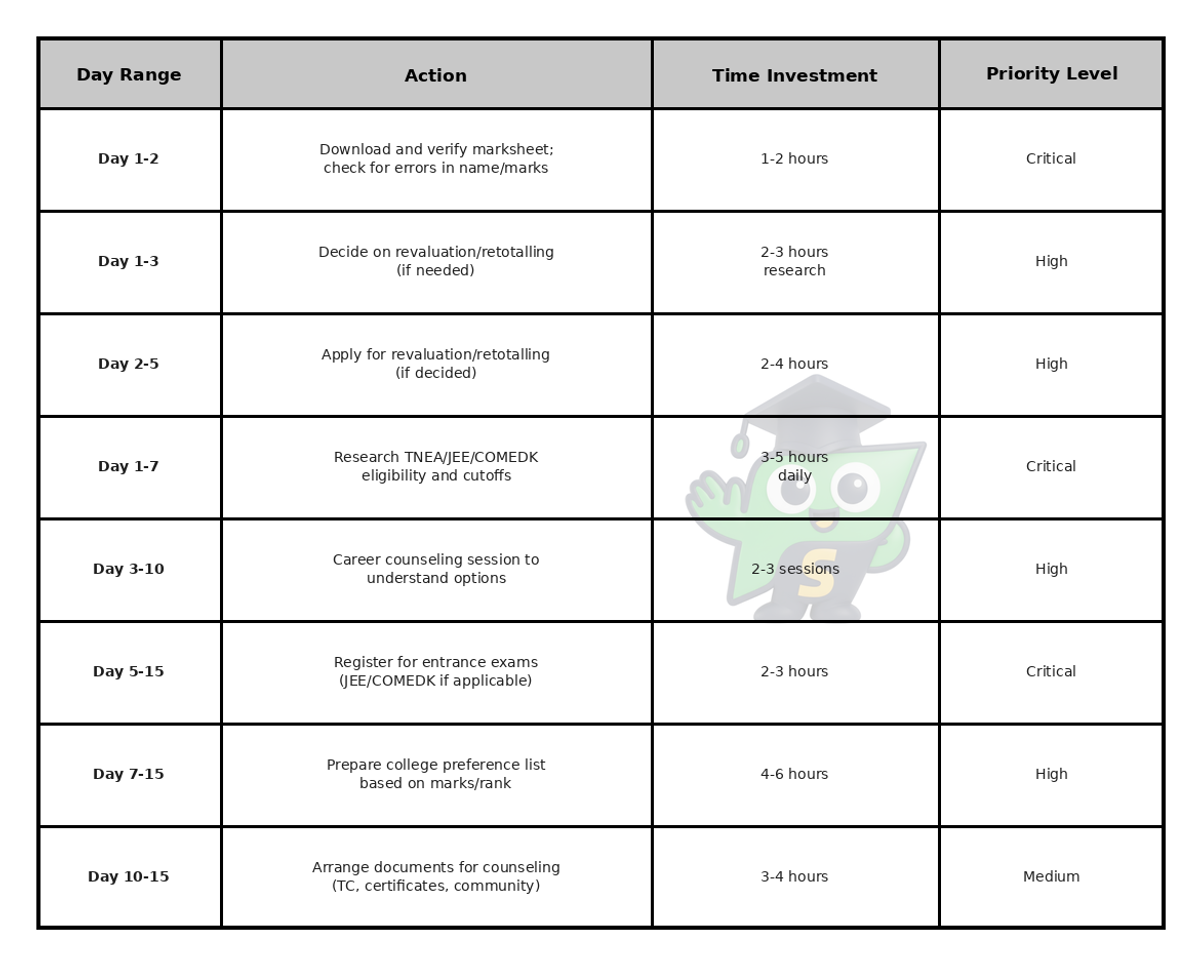
Days 1–2: Verify marksheet and process emotions.
Days 1–3: Decide on retotalling/revaluation; download answer sheets.
Days 2–5: Apply for corrections.
Days 1–7: Research TNEA/JEE/college options.
Days 3–10: Attend counseling sessions.
Days 5–15: Register for remaining entrance exams.
Days 7–15: Prepare preference lists.
Days 10–15: Gather and scan all documents.
How Parents Can Support During This Critical Phase
Parents should avoid comparisons, give children emotional space, and involve them in decisions. Support them with guidance, counseling, mental health resources (like Tele-MANAS 14416), and financial clarity. Research college options together and reassure them that marks do not define their worth.
How Prof Sam Can Help You Navigate This Journey
Prof Sam provides personalized, Tamil Nadu-focused guidance for TNEA, JEE, COMEDK, stream selection, drop-year decisions, and college choice filling. We analyze your marks, interests, budget, goals, and admission chances to create a clear, customized roadmap.
We help compare TNEA vs JEE options, evaluate private universities, understand cutoffs, prepare for counseling, and choose the right branch and college. Whether you scored high or low, we guide you step-by-step.
Complete Guide to Engineering Entrance Exams for Tamil Nadu Students
Related Topics
📌 How to choose a stream after Class Ten
📌 What to do if Class Twelve marks are low
📌 How to use Class Twelve marks in TNEA
📌 Class Ten marks and their future impact
📌 What subjects to pick for engineering
📌 How to plan if you scored very high in board exams
📌 How to handle confusion after results
📌 Should board exam marks decide your career?
📌 How to apply for colleges after results
📌 What to do if a student wants to switch streams
Final Thoughts: This Is Not the End, It Is the Beginning
Results bring mixed emotions, and that’s normal. But what you do next matters more. Verify your marks, research options, talk to counselors, and make informed choices. Marks don’t define you — your mindset and your next steps do. Many students with modest marks succeed because they choose wisely, stay consistent, and build strong skills.
This is just the beginning of your journey. Use this moment to make smart, confident decisions.
Need Personalized Guidance?
Book a consultation with Prof Sam and get expert advice tailored to your child's unique needs.
Book Your Consultation