
How to apply for colleges after results
Tamil Nadu student confused after results? Navigate TNEA, JEE Main, college choice, and fees with this clear, honest guide from Prof Sam.
Results are out. Your marks are public. Now comes the hardest part: figuring out where to study next.
For Tamil Nadu students, this is not a simple process. There is no single pathway. TNEA, JEE Main, direct admissions, fees, family pressure, and your own doubts all collide at once. This guide is here to sit with you through it, step by step.
Understanding Your Scores
First, understand what your numbers mean. Your board marks show how you performed among Tamil Nadu students in your stream. If you wrote JEE Main, your percentile shows your all-India ranking—a 90 percentile in JEE Main is far rarer than a 90 percentile in boards because lakhs of students compete nationwide. Your TNEA rank (if applicable) decides your position in the Tamil Nadu engineering college merit list.
These are not labels of "good" or "bad." They are keys that open different doors. Your job is to understand which ones yours can open.
The Two Main Routes: TNEA and JEE Main
Most Tamil Nadu students follow one or both of these paths.
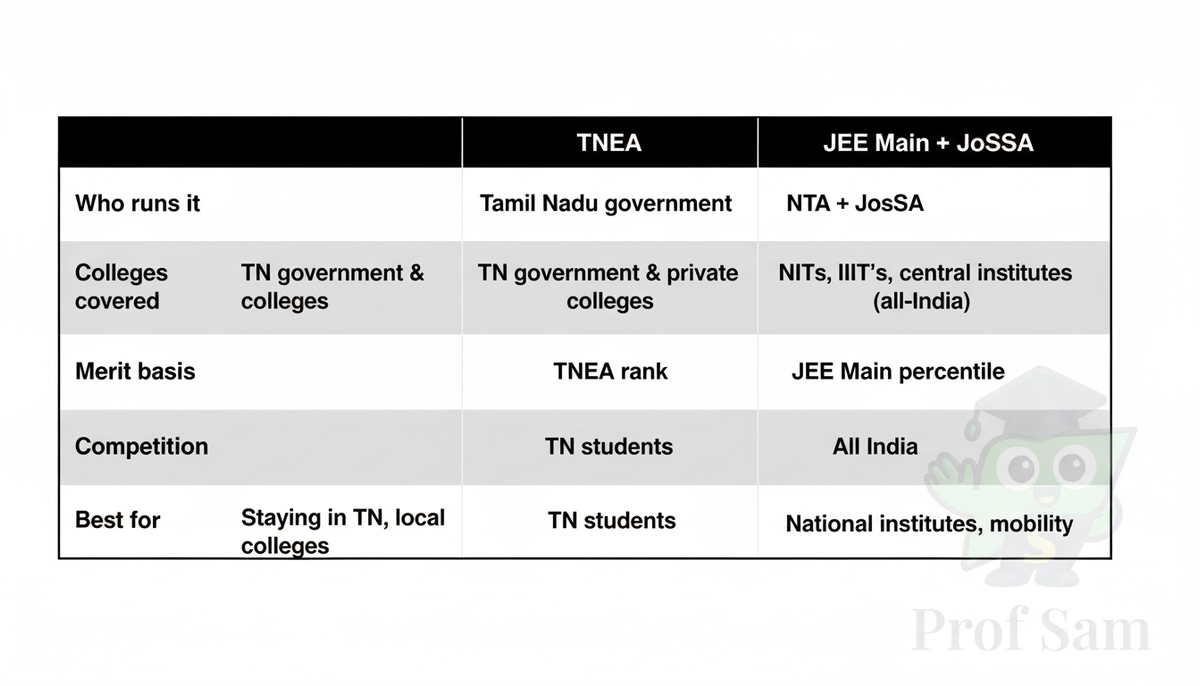
TNEA (Tamil Nadu Engineering Admissions) is run by the state government and covers government and many private engineering colleges in Tamil Nadu. You register on the TNEA portal, verify documents, and once your rank list is published, you get a short window to fill your college and branch preferences. The system then allocates seats based on your rank, category, and availability. This is your main route if you want to stay in Tamil Nadu.
JEE Main + JoSAA is the national route. Your JEE Main rank qualifies you for NITs, IIITs, and central institutes across India. The process mirrors TNEA: register, fill choices, get allotment. This is attractive if you want to study outside Tamil Nadu or aim for NIT Trichy. However, JEE competition is all-India, so your rank must be strong to get a good college.
Many students do both—they have TNEA as a local safety net and JEE as a national opportunity.
Timeline: What Happens When
Timing creates most of the panic. Multiple deadlines overlap, and missing one can close doors.
For TNEA: After results, registration opens (track the official TNEA portal dates). You have a specific window for choice filling—usually 5-7 days. Do not rush this. Research colleges before filling. After choice filling closes, the allocation happens in rounds, and you either confirm your seat or attempt later rounds.
For JoSAA: After JEE Main results, counseling dates are announced. Similar process—register, fill choices, wait for allotment. This usually happens 2-3 weeks after TNEA results.
Key point: Create a simple calendar with all deadlines. Missing a deadline by forgetting is a genuine risk that happens every year.
Choosing a College: Branch, Environment, and Money
When deciding, think in three layers.
Branch: What will you study every day for four years? If you love coding, Computer Science fits. If you prefer circuits and devices, ECE is better. If you dislike coding but love machines, Mechanical makes sense. Choose a branch you can see yourself engaging with, not just what is trendy.
College environment: Teaching quality, placements, peer group, and campus culture matter. A mid-tier college with a strong branch and good placements can be better than a "famous" college where your branch is weak.
Finances: This is not a minor point. Government colleges in Tamil Nadu cost ₹10,000-₹50,000 annually. Private colleges cost ₹1,50,000-₹6,00,000 per year. Big difference. If your family will be financially stressed by a college, it affects your studies and mental health. A more affordable college is often the wiser choice.
Common Mistakes to Avoid
Rushing choice filling: You panic and randomly order colleges without research. Later, you regret. Solution: spend one full day researching before filling. Check placements by branch, not just overall college ranking.
Chasing brand names only: You choose any branch in a "top" college even if you hate that field. Four years is long. Pick a decent college with a branch you actually like.
Ignoring finances silently: Your parents say "We will manage," but they are secretly scared of loans. Have an honest talk about budget. It is healthier.
All-or-nothing thinking: "If I don't get NIT, my life is over." Not true. Many successful professionals come from mid-tier colleges. Your effort matters far more than the college name.
When to Consider a Drop Year
A drop year might make sense if you have a clear plan, structured support (coaching, mentor), family acceptance, and emotional energy to try again. Drop Year Decision can help you think this through.
It usually is not a good idea if you are driven only by embarrassment, family pressure, or anger at yourself. Emotion alone is weak ground for such a big decision. For most students, joining a decent college now and working hard there is the better path.
How Parents Can Help
Listen more than you advise. Ask your child how they feel and what worries them. Be honest but calm about money—share clear budget ranges instead of hiding fears. Protect them from unnecessary comparison with cousins or neighbors. And involve them in decisions without forcing the final choice.
Book Your Career Consultation Today – Limited slots for personalized guidance.
Related Topics
📌 How to choose a stream after Class Ten
📌 What to do if Class Twelve marks are low
📌 How to use Class Twelve marks in TNEA
📌 Class Ten marks and their future impact
📌 What subjects to pick for engineering
📌 How to plan if you scored very high in board exams
📌 How to handle confusion after results
📌 Should board exam marks decide your career?
📌 How to apply for colleges after results
📌 What to do if a student wants to switch streams
Next Steps
Create a deadline tracker. Research 5-7 colleges you are genuinely interested in. Talk to your parents and at least one college senior. If you feel stuck, reach out to a mentor or counselor. Prof Sam's Complete Guide to Engineering Entrance Exams for Tamil Nadu Students and branch-selection support can help you choose with confidence, not panic.
Your marks matter. Your choice matters. But your effort and attitude in college matter far more than which college name is on your ID card.
Strengthen your Class 12 fundamentals on ScoreLab
Free video lessons, revision notes, formula sheets, and past-paper MCQs for CBSE Class 12.
Need Personalized Guidance?
Book a consultation with Prof Sam and get expert advice tailored to your child's unique needs.
Book Your Consultation